37–48. Polar-to-Cartesian coordinates Convert the following equations to Cartesian coordinates. Describe the resulting curve.
r = sin θ sec² θ
Verified step by step guidance
1
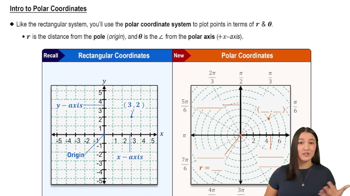
Recall the relationships between polar and Cartesian coordinates: \(x = r \cos \theta\) and \(y = r \sin \theta\). Also, \(r^2 = x^2 + y^2\).
Start with the given equation: \(r = \sin \theta \sec^2 \theta\). Rewrite \(\sec^2 \theta\) as \(\frac{1}{\cos^2 \theta}\), so the equation becomes \(r = \sin \theta \cdot \frac{1}{\cos^2 \theta}\).
Multiply both sides of the equation by \(\cos^2 \theta\) to get \(r \cos^2 \theta = \sin \theta\).
Express \(r \cos^2 \theta\) in terms of \(x\) and \(r\): since \(x = r \cos \theta\), then \(r \cos^2 \theta = x \cos \theta\). Also, express \(\sin \theta\) as \(\frac{y}{r}\).
Substitute these into the equation to get \(x \cos \theta = \frac{y}{r}\). Then, express \(\cos \theta\) as \(\frac{x}{r}\) and substitute back to write the entire equation in terms of \(x\), \(y\), and \(r\). Finally, replace \(r\) with \(\sqrt{x^2 + y^2}\) to obtain the Cartesian form of the curve.
Verified video answer for a similar problem:
This video solution was recommended by our tutors as helpful for the problem above
Video duration:
4m
Play a video:
0 Comments
Key Concepts
Here are the essential concepts you must grasp in order to answer the question correctly.
Polar and Cartesian Coordinate Systems
Polar coordinates represent points using a radius and an angle (r, θ), while Cartesian coordinates use x and y values. Understanding how to convert between these systems is essential, using the relationships x = r cos θ and y = r sin θ.
Trigonometric identities like sec θ = 1/cos θ and relationships between sine, cosine, and tangent functions help simplify expressions during conversion. Applying these identities allows rewriting polar equations in terms of x and y.
After substituting polar expressions with Cartesian variables, the resulting equation describes a curve in the xy-plane. Recognizing the form of this equation helps identify the type of curve, such as lines, circles, or conic sections.

 4:23 minutes
 Verified step by step guidance
 05:32
05:32