32–49. Choose your test Use the test of your choice to determine whether the following series converge absolutely, converge conditionally, or diverge. 1 / 1! + 4 / 2! + 9 / 3! + 16 / 4! + ⋯
Verified step by step guidance
1
Identify the general term of the series. Notice the pattern in the numerator and denominator: the numerator is \(n^2\) and the denominator is \(n!\). So the general term can be written as \(a_n = \frac{n^2}{n!}\).
To determine convergence, consider the absolute value of the terms. Since all terms are positive, absolute convergence is the same as convergence here.
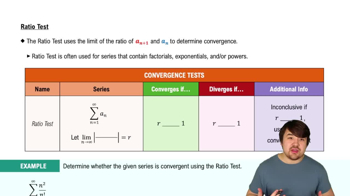
Apply the Ratio Test, which is useful for series involving factorials. The Ratio Test states to compute the limit \(L = \lim_{n \to \infty} \left| \frac{a_{n+1}}{a_n} \right|\).
Calculate the ratio \(\frac{a_{n+1}}{a_n} = \frac{\frac{(n+1)^2}{(n+1)!}}{\frac{n^2}{n!}} = \frac{(n+1)^2}{(n+1)!} \times \frac{n!}{n^2} = \frac{(n+1)^2}{(n+1) \times n^2} = \frac{n+1}{n^2}\).
Evaluate the limit \(L = \lim_{n \to \infty} \frac{n+1}{n^2}\). Since this limit approaches 0, which is less than 1, the Ratio Test tells us the series converges absolutely.
Verified video answer for a similar problem:
This video solution was recommended by our tutors as helpful for the problem above
Video duration:
2m
Play a video:
0 Comments
Key Concepts
Here are the essential concepts you must grasp in order to answer the question correctly.
Absolute and Conditional Convergence
Absolute convergence occurs when the series of absolute values converges, ensuring the original series converges regardless of term signs. Conditional convergence happens when the series converges but not absolutely, meaning the series converges only due to the arrangement of terms. Understanding these helps classify the behavior of infinite series.
The Ratio Test determines convergence by examining the limit of the absolute value of the ratio of consecutive terms. If this limit is less than one, the series converges absolutely; if greater than one, it diverges; if equal to one, the test is inconclusive. This test is especially useful for series involving factorials or exponentials.
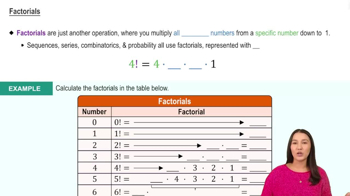
Factorials grow faster than polynomial expressions, which affects the convergence of series with terms involving factorials in the denominator. Recognizing how factorial growth compares to polynomial or exponential growth helps in applying convergence tests effectively, as factorial terms often lead to rapid decay of series terms.