In Exercises 19–26, use implicit differentiation to find dy/dx and then d²y/dx². Write the solutions in terms of x and y only.
3 + sin y = y – x³
Verified step by step guidance
1
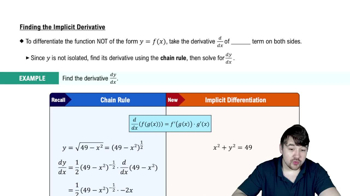
Start by differentiating both sides of the equation 3 + sin(y) = y - x³ with respect to x. Remember that y is a function of x, so use implicit differentiation.
Differentiate the left side: The derivative of 3 is 0, and the derivative of sin(y) with respect to x is cos(y) * (dy/dx) using the chain rule.
Differentiate the right side: The derivative of y with respect to x is dy/dx, and the derivative of -x³ is -3x².
Set the derivatives equal: cos(y) * (dy/dx) = dy/dx - 3x². Solve this equation for dy/dx.
To find the second derivative d²y/dx², differentiate the expression for dy/dx with respect to x again. Use implicit differentiation and the chain rule where necessary, and express the result in terms of x and y.
Verified video answer for a similar problem:
This video solution was recommended by our tutors as helpful for the problem above
Video duration:
6m
Play a video:
0 Comments
Key Concepts
Here are the essential concepts you must grasp in order to answer the question correctly.
Implicit Differentiation
Implicit differentiation is a technique used to differentiate equations where y is not explicitly solved for in terms of x. Instead of isolating y, we differentiate both sides of the equation with respect to x, applying the chain rule when differentiating y. This allows us to find dy/dx in terms of both x and y, which is essential for solving equations that define y implicitly.
The first derivative, denoted as dy/dx, represents the rate of change of y with respect to x. It provides information about the slope of the tangent line to the curve defined by the equation at any point. In the context of implicit differentiation, finding dy/dx allows us to understand how y changes as x varies, which is crucial for further analysis, such as finding the second derivative.
The second derivative, denoted as d²y/dx², measures the rate of change of the first derivative, indicating how the slope of the tangent line is changing. It provides insights into the concavity of the function and can reveal points of inflection. To find d²y/dx² using implicit differentiation, we differentiate dy/dx again, applying the product and chain rules, and express the result in terms of x and y.