119. {Use of Tech} Comparing volumes Let R be the region bounded by y = ln(x), the x-axis, and the line x = a, where a > 1. b. Find the volume V₂(a) of the solid generated when R is revolved about the y-axis (as a function of a).
Verified step by step guidance
1
First, identify the region R bounded by the curves: the graph of \(y = \ln(x)\), the x-axis (\(y=0\)), and the vertical line \(x = a\) where \(a > 1\). This region lies between \(x=1\) (since \(\ln(1) = 0\)) and \(x=a\) along the x-axis, and between \(y=0\) and \(y=\ln(a)\) along the y-axis.
Since the solid is generated by revolving the region R about the y-axis, consider using the method of cylindrical shells. The shell radius will be the distance from the y-axis, which is \(x\), and the shell height will be the vertical distance between the curves, which is \(\ln(x) - 0 = \ln(x)\).
The volume of the solid using the shell method is given by the integral formula:
\(V_2(a) = \int_{x=1}^{a} 2\pi \cdot (\text{radius}) \cdot (\text{height}) \, dx = \int_{1}^{a} 2\pi x \ln(x) \, dx\).
Set up the integral explicitly:
\(V_2(a) = 2\pi \int_{1}^{a} x \ln(x) \, dx\).
To evaluate the integral, use integration by parts where you let \(u = \ln(x)\) and \(dv = x \, dx\). Then compute \(du = \frac{1}{x} \, dx\) and \(v = \frac{x^2}{2}\). Apply the integration by parts formula:
\(\int u \, dv = uv - \int v \, du\).
Verified video answer for a similar problem:
This video solution was recommended by our tutors as helpful for the problem above
Video duration:
4m
Play a video:
0 Comments
Key Concepts
Here are the essential concepts you must grasp in order to answer the question correctly.
Region Bounded by Curves
Understanding the region R involves identifying the area enclosed by the curve y = ln(x), the x-axis (y = 0), and the vertical line x = a. This sets the limits for integration and defines the shape whose volume is to be found when revolved.
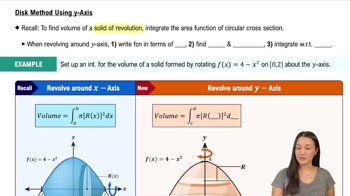
To find the volume generated by revolving a region around the y-axis, methods like the shell method or the washer method are used. For this problem, the shell method is often preferred, integrating cylindrical shells with radius x and height given by the function.
Calculating the volume requires integrating expressions involving ln(x). Familiarity with integration techniques for logarithmic functions, such as integration by parts, is essential to evaluate the integral and express the volume as a function of a.