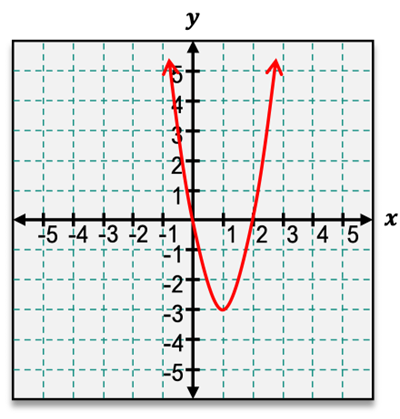
For the following graph, find the open intervals for which the function is concave up or concave down. Identify any inflection points.
Table of contents
- 0. Functions7h 55m
- Introduction to Functions18m
- Piecewise Functions10m
- Properties of Functions9m
- Common Functions1h 8m
- Transformations5m
- Combining Functions27m
- Exponent rules32m
- Exponential Functions28m
- Logarithmic Functions24m
- Properties of Logarithms36m
- Exponential & Logarithmic Equations35m
- Introduction to Trigonometric Functions38m
- Graphs of Trigonometric Functions44m
- Trigonometric Identities47m
- Inverse Trigonometric Functions48m
- 1. Limits and Continuity2h 2m
- 2. Intro to Derivatives1h 33m
- 3. Techniques of Differentiation3h 18m
- 4. Applications of Derivatives2h 38m
- 5. Graphical Applications of Derivatives6h 2m
- 6. Derivatives of Inverse, Exponential, & Logarithmic Functions2h 37m
- 7. Antiderivatives & Indefinite Integrals1h 26m
- 8. Definite Integrals4h 44m
- 9. Graphical Applications of Integrals2h 27m
- 10. Physics Applications of Integrals 3h 16m
- 11. Integrals of Inverse, Exponential, & Logarithmic Functions2h 31m
- 12. Techniques of Integration7h 41m
- 13. Intro to Differential Equations2h 55m
- 14. Sequences & Series5h 36m
- 15. Power Series2h 19m
- 16. Parametric Equations & Polar Coordinates7h 58m
5. Graphical Applications of Derivatives
Concavity
Multiple Choice
The graph of f′′(x) is shown below. Use the graph to determine the intervals for which f(x)is concave up or concave down and the location of any inflection points.

A
Concave down: (−1,0), (2,∞); Concave up: (0,2); Inflection points: x=0, x=2
B
Concave down: (−1,0), (2,∞); Concave up: (0,2); Inflection points: x=−1, x=0, x=2
C
Concave up: (−∞,0), (2,∞); Concave down: (0,2); Inflection points: x=0, x=2
D
Concave up: (−∞,−1), (0,∞); Concave down: (−1,0); Inflection points: x=−1, x=0
0 Comments
Verified step by step guidance1
To determine the concavity of f(x), we need to analyze the graph of f''(x). The graph provided is a parabola opening upwards, which represents f''(x).
The function f(x) is concave up where f''(x) > 0. From the graph, f''(x) is positive for x < 0 and x > 2.
The function f(x) is concave down where f''(x) < 0. From the graph, f''(x) is negative for 0 < x < 2.
Inflection points occur where f''(x) changes sign. From the graph, this happens at x = 0 and x = 2.
Thus, the intervals of concavity and inflection points are: Concave up on (-∞, 0) and (2, ∞); Concave down on (0, 2); Inflection points at x = 0 and x = 2.
Related Videos
Related Practice
Multiple Choice
297
views
3
rank