Find the following limits or state that they do not exist. Assume a, b, c, and k are fixed real numbers.
Verified step by step guidance
1
Step 1: Recognize that the limit involves a trigonometric expression. The numerator is \(1 - \cos(x)\), which can be approximated using the Taylor series expansion for \(\cos(x)\) around \(x = 0\): \(\cos(x) \approx 1 - \frac{x^2}{2}\). Therefore, \(1 - \cos(x) \approx \frac{x^2}{2}\) for small \(x\).
Step 2: Factor the denominator \(\cos^2(x) - 3\cos(x) + 2\). Notice that this is a quadratic in terms of \(\cos(x)\). Let \(y = \cos(x)\), then the expression becomes \(y^2 - 3y + 2\). Factor this quadratic to get \((y - 1)(y - 2)\). Therefore, \(\cos^2(x) - 3\cos(x) + 2 = (\cos(x) - 1)(\cos(x) - 2)\).
Step 3: Substitute the factored form of the denominator back into the limit expression: \(\lim_{x \to 0} \frac{1 - \cos(x)}{(\cos(x) - 1)(\cos(x) - 2)}\). Notice that \(\cos(x) - 1\) is a common factor in both the numerator and the denominator.
Step 4: Simplify the expression by canceling the common factor \(\cos(x) - 1\) from the numerator and the denominator. This gives \(\lim_{x \to 0} \frac{1}{\cos(x) - 2}\).
Step 5: Evaluate the simplified limit as \(x\) approaches 0. Since \(\cos(0) = 1\), substitute \(x = 0\) into the simplified expression to find the limit.
Verified video answer for a similar problem:
This video solution was recommended by our tutors as helpful for the problem above
Video duration:
3m
Play a video:
0 Comments
Key Concepts
Here are the essential concepts you must grasp in order to answer the question correctly.
Limits
Limits are fundamental in calculus, representing the value that a function approaches as the input approaches a certain point. In this question, we are tasked with finding the limit of a function as x approaches 0. Understanding how to evaluate limits, especially when direct substitution leads to indeterminate forms, is crucial for solving the problem.
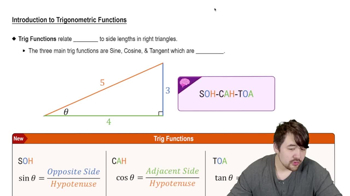
Trigonometric functions, such as cosine, are periodic functions that relate angles to ratios of sides in right triangles. In this limit problem, the behavior of the cosine function as x approaches 0 is essential, particularly since the limit involves expressions like 1 - cos(x). Familiarity with the properties and values of trigonometric functions at specific angles aids in simplifying the limit.
Indeterminate forms occur when direct substitution in a limit leads to expressions like 0/0 or ∞/∞, which do not provide clear information about the limit's value. In this case, substituting x = 0 into the given limit results in the form 0/0. Recognizing and resolving indeterminate forms, often through techniques like L'Hôpital's Rule or algebraic manipulation, is essential for finding the correct limit.

 3:59 minutes
 Verified step by step guidance

 05:50
05:50