
Use calculus to find the arc length of the line segment x=3t+1, y=4t, for 0≤t≤1. Check your work by finding the distance between the endpoints of the line segment.
Verified step by step guidance
1
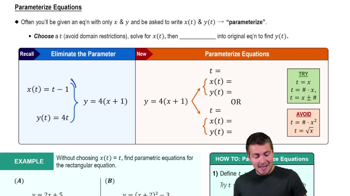
Identify the parametric equations given: \(x(t) = 3t + 1\) and \(y(t) = 4t\), with the parameter \(t\) ranging from 0 to 1.
Find the derivatives of \(x(t)\) and \(y(t)\) with respect to \(t\): compute \(\frac{dx}{dt}\) and \(\frac{dy}{dt}\).
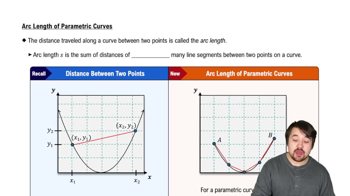
Use the arc length formula for parametric curves: \(L = \int_{a}^{b} \sqrt{\left(\frac{dx}{dt}\right)^2 + \left(\frac{dy}{dt}\right)^2} \, dt\), where \(a=0\) and \(b=1\).
Substitute the derivatives into the integral and simplify the expression inside the square root to prepare for integration.
Evaluate the integral to find the arc length, then verify your result by calculating the straight-line distance between the endpoints \((x(0), y(0))\) and \((x(1), y(1))\) using the distance formula \(d = \sqrt{(x_2 - x_1)^2 + (y_2 - y_1)^2}\).
Verified video answer for a similar problem:
This video solution was recommended by our tutors as helpful for the problem above
Video duration:
2m
Play a video:
0 Comments
Key Concepts
Here are the essential concepts you must grasp in order to answer the question correctly.
Parametric Equations
Parametric equations express the coordinates of points on a curve as functions of a parameter, often denoted as t. In this problem, x and y are given in terms of t, allowing us to analyze the curve's properties by differentiating with respect to t.
The arc length of a curve defined parametrically by x(t) and y(t) from t=a to t=b is found by integrating the square root of the sum of the squares of the derivatives: ∫ₐᵇ √((dx/dt)² + (dy/dt)²) dt. This formula calculates the length of the curve between two parameter values.
The distance between two points (x₁, y₁) and (x₂, y₂) in the plane is given by the formula √((x₂ - x₁)² + (y₂ - y₁)²). This provides a way to verify the arc length for a straight line segment by comparing it to the direct distance between endpoints.