In Exercises 35–40, write a differential formula that estimates the given change in volume or surface area.
The change in the volume V = x³ of a cube when the edge lengths change from x₀ to x₀ + dx
Verified step by step guidance
1
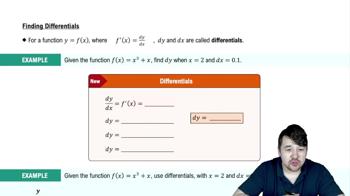
Start by understanding the concept of differentials. Differentials are used to approximate changes in functions. In this case, we want to estimate the change in the volume of a cube as its edge length changes slightly.
The volume of a cube is given by the formula V = x³, where x is the length of an edge of the cube.
To find the differential formula, we need to differentiate the volume function V = x³ with respect to x. This will give us the rate of change of the volume with respect to the edge length.
Differentiate V = x³ with respect to x to get dV/dx = 3x². This derivative represents how the volume changes as the edge length changes.
The differential formula for the change in volume is given by dV = 3x² dx, where dx is the small change in the edge length. This formula estimates the change in volume when the edge length changes from x₀ to x₀ + dx.
Verified video answer for a similar problem:
This video solution was recommended by our tutors as helpful for the problem above
Video duration:
2m
Play a video:
0 Comments
Key Concepts
Here are the essential concepts you must grasp in order to answer the question correctly.
Differential Calculus
Differential calculus focuses on the concept of the derivative, which represents the rate of change of a function with respect to a variable. In this context, it helps estimate how a small change in the edge length of a cube affects its volume. The derivative provides a linear approximation of the function's behavior near a specific point.
The volume of a cube is calculated using the formula V = x³, where x is the length of one edge. Understanding this formula is crucial because it forms the basis for determining how changes in the edge length affect the cube's volume. The relationship between the edge length and volume is cubic, meaning small changes in x can lead to significant changes in volume.
A differential formula provides an approximation for the change in a function's value due to a small change in its input. For a function V = x³, the differential dV is given by dV = 3x² dx, where dx is the small change in x. This formula estimates the change in volume when the cube's edge length changes slightly, using the derivative of the volume function.