23–26. Stirred tank reactions For each of the following stirred tank reactions, carry out the following analysis. b. Solve the initial value problem.
A one-million-liter pond is contaminated by a chemical pollutant with a concentration of 20 g/L. The source of the pollutant is removed, and pure water is allowed to flow into the pond at a rate of 1200 L/hr. Assuming the pond is thoroughly mixed and drained at a rate of 1200 L/hr, how long does it take to reduce the concentration of the solution in the pond to 10% of the initial value?
Verified step by step guidance
1
Define the variables: let \(C(t)\) be the concentration of the pollutant in the pond at time \(t\) (in hours), measured in grams per liter (g/L). The initial concentration is \(C(0) = 20\) g/L.
Set up the differential equation based on the mixing and flow rates. Since pure water flows in and the mixture flows out at the same rate, the volume remains constant at 1,000,000 L. The rate of change of pollutant mass in the pond is given by the difference between pollutant inflow and outflow:
Since the inflow is pure water, the inflow rate of pollutant is zero. The outflow rate of pollutant is the concentration times the outflow volume rate:
\[ \frac{d}{dt} (V \cdot C) = 0 - (1200 \text{ L/hr}) \times C(t) \]
Because the volume \(V\) is constant, rewrite the equation as:
\[ V \frac{dC}{dt} = -1200 C(t) \]
Divide both sides by \(V\) to get the first-order linear differential equation:
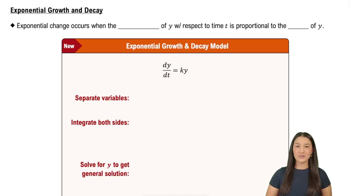
Solve this differential equation using separation of variables or recognizing it as an exponential decay:
\[ C(t) = C(0) e^{-\frac{1200}{1,000,000} t} \]
Use the condition that the concentration reduces to 10% of the initial value, i.e., \(C(t) = 0.1 \times 20 = 2\) g/L, and solve for \(t\):
\[ 2 = 20 e^{-\frac{1200}{1,000,000} t} \]
Take the natural logarithm of both sides and solve for \(t\) to find the time required to reach the desired concentration.
Verified video answer for a similar problem:
This video solution was recommended by our tutors as helpful for the problem above
Video duration:
7m
Play a video:
0 Comments
Key Concepts
Here are the essential concepts you must grasp in order to answer the question correctly.
Formulating the Differential Equation for Mixing Problems
In stirred tank problems, the concentration changes over time due to inflow and outflow. The rate of change of pollutant mass is modeled by a first-order differential equation, balancing the pollutant entering and leaving the system. Since pure water flows in, only outflow reduces concentration, leading to a separable ODE describing concentration decay.
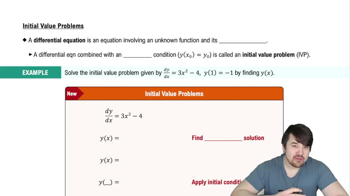
An initial value problem involves solving a differential equation with a given initial condition. Here, the initial concentration is known, and the solution describes concentration over time. Techniques like separation of variables or integrating factors help find explicit formulas to predict pollutant levels at any time.
Exponential Decay and Time to Reach a Specific Concentration
When a pollutant concentration decreases proportionally to its current value, the solution exhibits exponential decay. To find the time to reach a certain fraction of the initial concentration, set the solution equal to that fraction and solve for time, often involving natural logarithms.