87. Explain why or why not Determine whether the following statements are true and give an explanation or counterexample.
c. If ∑ aₖ converges, then ∑ (aₖ + 0.0001) converges.
Verified step by step guidance
1
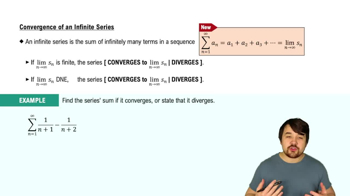
Recall the definition of convergence for an infinite series: A series \( \sum a_k \) converges if the sequence of its partial sums \( S_n = \sum_{k=1}^n a_k \) approaches a finite limit as \( n \to \infty \).
Consider the given series \( \sum a_k \) which converges, meaning \( \lim_{n \to \infty} S_n = L \) for some finite number \( L \).
Now examine the series \( \sum (a_k + 0.0001) \). This can be rewritten as \( \sum a_k + \sum 0.0001 \). Since \( \sum 0.0001 = 0.0001 + 0.0001 + \cdots \) is a constant term added infinitely many times, it forms a divergent series (because the partial sums grow without bound).
Because \( \sum 0.0001 \) diverges, adding it to the convergent series \( \sum a_k \) results in a series whose partial sums tend to infinity, hence \( \sum (a_k + 0.0001) \) diverges.
Therefore, the statement 'If \( \sum a_k \) converges, then \( \sum (a_k + 0.0001) \) converges' is false, and the counterexample is the constant addition of a positive number to each term.
Verified video answer for a similar problem:
This video solution was recommended by our tutors as helpful for the problem above
Video duration:
2m
Play a video:
0 Comments
Key Concepts
Here are the essential concepts you must grasp in order to answer the question correctly.
Convergence of Infinite Series
An infinite series ∑ aₖ converges if the sequence of its partial sums approaches a finite limit. This means the sum of infinitely many terms settles to a specific value, rather than growing without bound or oscillating indefinitely.
Adding a constant to each term of a series changes the behavior of the partial sums. Specifically, adding a nonzero constant shifts each term, which can cause the partial sums to grow without bound, potentially making the new series diverge.
Solving Separable Differential Equations Example 2
Counterexample to Test Series Convergence
A counterexample demonstrates that a general statement is false by providing a specific case where it fails. For series, showing that adding a constant to a convergent series results in divergence disproves the claim that the new series always converges.

 2:07 minutes
 Verified step by step guidance
 06:52
06:52