First, identify the type of limit problem. This is a limit of a quotient as x approaches -3. The expression is (2 - √(x² - 5)) / (x + 3).
Check if direct substitution of x = -3 into the expression results in an indeterminate form. Substitute -3 into the expression: (2 - √((-3)² - 5)) / (-3 + 3). This results in 0/0, which is indeterminate.
Since direct substitution results in an indeterminate form, consider using algebraic manipulation to simplify the expression. One common technique is to multiply the numerator and the denominator by the conjugate of the numerator: (2 + √(x² - 5)).
Multiply the numerator and the denominator by the conjugate: [(2 - √(x² - 5))(2 + √(x² - 5))] / [(x + 3)(2 + √(x² - 5))]. This will help eliminate the square root in the numerator.
Simplify the expression. The numerator becomes (2² - (x² - 5)) due to the difference of squares, which simplifies to (4 - x² + 5). The denominator remains (x + 3)(2 + √(x² - 5)). Simplify further and then evaluate the limit as x approaches -3.
Verified video answer for a similar problem:
This video solution was recommended by our tutors as helpful for the problem above
Video duration:
5m
Play a video:
0 Comments
Key Concepts
Here are the essential concepts you must grasp in order to answer the question correctly.
Limits
Limits are fundamental in calculus, representing the value that a function approaches as the input approaches a certain point. They help in understanding the behavior of functions near points of interest, especially where they may not be defined. In this case, we are interested in the limit as x approaches -3, which requires evaluating the function's behavior near that point.
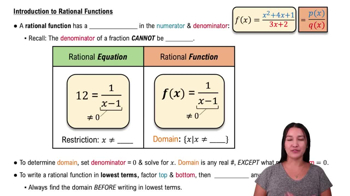
A rational function is a ratio of two polynomials. In the given limit problem, the expression involves a quotient, which can lead to indeterminate forms like 0/0 when substituting the limit directly. Understanding how to manipulate these functions, such as factoring or simplifying, is crucial for finding the limit.
L'Hôpital's Rule is a method used to evaluate limits of indeterminate forms, such as 0/0 or ∞/∞. It states that if the limit of f(x)/g(x) results in an indeterminate form, the limit can be found by taking the derivative of the numerator and the derivative of the denominator. This rule can simplify the process of finding limits in complex expressions.

 5:14 minutes
 Verified step by step guidance

 05:50
05:50