For the following regions R, determine which is greater—the volume of the solid generated when R is revolved about the x-axis or about the y-axis.
R is bounded by y=1−x^3, the x-axis, and the y-axis.
Verified step by step guidance
1
Step 1: Understand the problem. The region R is bounded by the curve y = 1 - x³, the x-axis, and the y-axis. We need to compare the volumes of solids generated when this region is revolved about the x-axis and the y-axis.
Step 2: Set up the volume formula for revolution about the x-axis. Use the disk method, where the volume is given by: . Here, y = 1 - x³, and the limits of integration are from x = 0 to x = 1 (since the region is bounded by the y-axis and the curve).
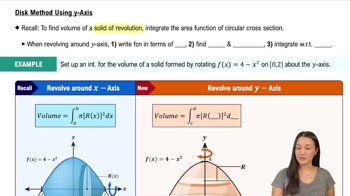
Step 3: Set up the volume formula for revolution about the y-axis. Use the shell method, where the volume is given by: . Again, y = 1 - x³, and the limits of integration are from x = 0 to x = 1.
Step 4: Compare the integrals. For the x-axis revolution, the integral involves squaring the function y = 1 - x³, resulting in . For the y-axis revolution, the integral involves multiplying x by the function y = 1 - x³, resulting in . Both integrals need to be evaluated to determine which volume is greater.
Step 5: Analyze the results conceptually. The volume about the x-axis depends on the square of the height of the region (y-values), while the volume about the y-axis depends on the product of the radius (x-values) and the height (y-values). This comparison requires evaluating the integrals, but the setup allows us to proceed systematically.
Verified video answer for a similar problem:
This video solution was recommended by our tutors as helpful for the problem above
Video duration:
7m
Play a video:
0 Comments
Key Concepts
Here are the essential concepts you must grasp in order to answer the question correctly.
Volume of Revolution
The volume of revolution refers to the volume of a solid formed by rotating a two-dimensional area around an axis. This can be calculated using methods such as the disk method or the washer method, depending on whether the solid has a hole in it. The choice of axis (x-axis or y-axis) significantly affects the volume calculation, as it determines the shape and dimensions of the resulting solid.
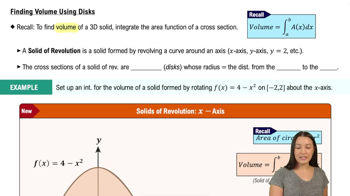
The disk and washer methods are techniques used to calculate the volume of solids of revolution. The disk method is applied when the solid has no hole, using the formula V = π∫[f(x)]²dx for rotation about the x-axis. The washer method is used when there is a hole, incorporating an outer and inner radius, and is expressed as V = π∫([R(x)]² - [r(x)]²)dx, allowing for the calculation of volumes for more complex shapes.
Bounded regions in calculus refer to areas enclosed by curves and lines, which can be analyzed for various properties, including area and volume. In this question, the region R is defined by the curve y = 1 - x³, the x-axis, and the y-axis. Understanding the boundaries of R is crucial for setting up the correct integrals to compute the volumes when the region is revolved around the x-axis or y-axis.