Simplify the expression inside the limit: Combine like terms in the numerator to get \( 6x \), so the expression becomes \( \left( \frac{6x}{x + 2} \right)^4 \).
Substitute \( x = 1 \) into the simplified expression: \( \frac{6(1)}{1 + 2} = \frac{6}{3} = 2 \).
Raise the result to the power of 4: \( 2^4 \).
Conclude that the limit is the value obtained from the previous step.
Verified video answer for a similar problem:
This video solution was recommended by our tutors as helpful for the problem above
Video duration:
1m
Play a video:
0 Comments
Key Concepts
Here are the essential concepts you must grasp in order to answer the question correctly.
Limits
A limit is a fundamental concept in calculus that describes the behavior of a function as its input approaches a certain value. It helps in understanding how functions behave near specific points, which is crucial for evaluating expressions that may be undefined at those points. In this case, we need to analyze the limit as x approaches 1 to determine the value of the expression.
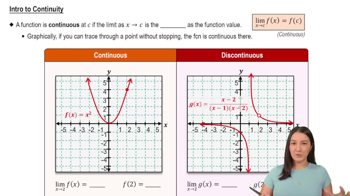
A function is continuous at a point if the limit of the function as it approaches that point equals the function's value at that point. This concept is essential when evaluating limits, as it allows us to substitute the value directly into the function if it is continuous at that point. For the given limit, checking the continuity of the function at x = 1 will help simplify the evaluation.
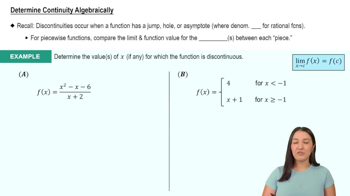
Algebraic simplification involves manipulating an expression to make it easier to evaluate, especially when dealing with limits. This can include factoring, canceling common terms, or rewriting expressions in a more manageable form. In the limit provided, simplifying the expression before taking the limit can help avoid indeterminate forms and lead to a clearer solution.

 1:54 minutes
 Verified step by step guidance

 05:50
05:50