Compute the following limits or state that they do not exist. limx→−1 f(x)
Verified step by step guidance
1
Identify the piecewise function f(x) and the point of interest, which is x = -1. The function is defined as f(x) = x^2 + 1 for x < -1 and f(x) = \(\sqrt{x}\) + 1 for x \(\geq\) -1.
To find the limit as x approaches -1, consider the left-hand limit (as x approaches -1 from the left) and the right-hand limit (as x approaches -1 from the right) separately.
Calculate the left-hand limit: lim_{x \(\to\) -1^-} f(x) = lim_{x \(\to\) -1^-} (x^2 + 1). Substitute x = -1 into the expression x^2 + 1 to find the left-hand limit.
Calculate the right-hand limit: lim_{x \(\to\) -1^+} f(x) = lim_{x \(\to\) -1^+} (\(\sqrt{x}\) + 1). Substitute x = -1 into the expression \(\sqrt{x}\) + 1 to find the right-hand limit.
Compare the left-hand and right-hand limits. If they are equal, the limit exists and is equal to this common value. If they are not equal, the limit does not exist.
Verified video answer for a similar problem:
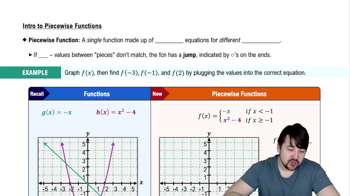
This video solution was recommended by our tutors as helpful for the problem above
Video duration:
2m
Play a video:
0 Comments
Key Concepts
Here are the essential concepts you must grasp in order to answer the question correctly.
Piecewise Functions
A piecewise function is defined by different expressions based on the input value. In this case, f(x) has two distinct formulas: one for x < -1 and another for x ≥ -1. Understanding how to evaluate piecewise functions is crucial for determining limits at points where the function's definition changes.
A limit describes the behavior of a function as the input approaches a certain value. To compute the limit of f(x) as x approaches -1, we need to evaluate the function from both sides of -1, using the appropriate piece of the function for each side. This helps us determine if the limit exists and what its value is.
Left-hand and right-hand limits refer to the values that a function approaches as the input approaches a specific point from the left or right, respectively. For the limit of f(x) as x approaches -1, we must calculate the left-hand limit (using x < -1) and the right-hand limit (using x ≥ -1) to see if they are equal, which would indicate the overall limit exists.
