Suppose f and g have continuous derivatives on an interval [a, b]. Prove that if f(a)=g(a) and f(b)=g(b), then β«a^b fβ²(x) dx = β«a^b gβ²(x) dx.
Table of contents
- 0. Functions7h 55m
- Introduction to Functions18m
- Piecewise Functions10m
- Properties of Functions9m
- Common Functions1h 8m
- Transformations5m
- Combining Functions27m
- Exponent rules32m
- Exponential Functions28m
- Logarithmic Functions24m
- Properties of Logarithms36m
- Exponential & Logarithmic Equations35m
- Introduction to Trigonometric Functions38m
- Graphs of Trigonometric Functions44m
- Trigonometric Identities47m
- Inverse Trigonometric Functions48m
- 1. Limits and Continuity2h 2m
- 2. Intro to Derivatives1h 33m
- 3. Techniques of Differentiation3h 18m
- 4. Applications of Derivatives2h 38m
- 5. Graphical Applications of Derivatives6h 2m
- 6. Derivatives of Inverse, Exponential, & Logarithmic Functions2h 37m
- 7. Antiderivatives & Indefinite Integrals1h 26m
- 8. Definite Integrals4h 44m
- 9. Graphical Applications of Integrals2h 27m
- 10. Physics Applications of Integrals 3h 16m
- 11. Integrals of Inverse, Exponential, & Logarithmic Functions2h 31m
- 12. Techniques of Integration7h 41m
- 13. Intro to Differential Equations2h 55m
- 14. Sequences & Series5h 36m
- 15. Power Series2h 19m
- 16. Parametric Equations & Polar Coordinates7h 58m
8. Definite Integrals
Fundamental Theorem of Calculus
Problem 5.4.59b
Textbook Question
Generalizing the Mean Value Theorem for Integrals Suppose Ζ and g are continuous on [a, b] and let h(π) = (πβb) β«βΛ£ Ζ(t) dt + (πβa) β«βα΅g(t)dt.
(b) Show that there is a number c in (a, b) such that β«βαΆ Ζ(t) dt = Ζ(c) (b β c)
(Source: The College Mathematics Journal, 33, 5, Nov 2002)
Verified step by step guidance1
Start by recalling the given function: \(h(\mathcal{x}) = (\mathcal{x} - b) \int_a^{\mathcal{x}} f(t) \, dt + (\mathcal{x} - a) \int_{\mathcal{x}}^b g(t) \, dt\). We are asked to show that there exists a \(c \in (a,b)\) such that \(\int_a^c f(t) \, dt = f(c)(b - c)\).
Focus on the part of the problem involving \(f\). Consider the function \(H(x) = (x - b) \int_a^x f(t) \, dt\). Notice that this is part of \(h(x)\) and involves the integral of \(f\) from \(a\) to \(x\).
Differentiate \(H(x)\) with respect to \(x\) using the product rule and the Fundamental Theorem of Calculus. Recall that if \(F(x) = \int_a^x f(t) \, dt\), then \(F'(x) = f(x)\). So,
\(H'(x) = \frac{d}{dx} \left[(x - b) F(x)\right] = F(x) + (x - b) f(x)\).
Set \(H'(c) = 0\) for some \(c \in (a,b)\) to find a critical point. This gives the equation:
\(F(c) + (c - b) f(c) = 0\).
Rewrite this as:
\(\int_a^c f(t) \, dt = f(c)(b - c)\), which is exactly what we want to prove.
To justify the existence of such a \(c\), apply Rolle's Theorem or the Mean Value Theorem to \(H(x)\) on \([a,b]\). Since \(H(a) = H(b) = 0\), there must be some \(c \in (a,b)\) where \(H'(c) = 0\), completing the proof.
Verified video answer for a similar problem:This video solution was recommended by our tutors as helpful for the problem above
Video duration:
4mPlay a video:
0 Comments
Key Concepts
Here are the essential concepts you must grasp in order to answer the question correctly.
Mean Value Theorem for Integrals
This theorem states that if a function is continuous on [a, b], there exists a point c in (a, b) where the integral average equals the function value, i.e., β«βα΅ f(t) dt = f(c)(b - a). It connects the average value of a function over an interval to a specific function value inside that interval.
Recommended video:
Fundamental Theorem of Calculus Part 1
Fundamental Theorem of Calculus
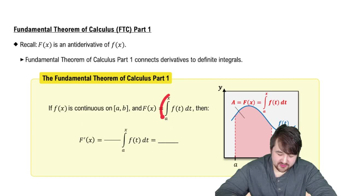
This theorem links differentiation and integration, stating that if F(x) = β«βΛ£ f(t) dt, then F'(x) = f(x). It allows us to differentiate integral expressions and is essential for analyzing functions defined by integrals, like h(x) in the problem.
Recommended video:
Fundamental Theorem of Calculus Part 1
Continuity and Intermediate Value Property
Continuity of functions f and g on [a, b] ensures the integrals and constructed functions are well-behaved. The Intermediate Value Theorem guarantees the existence of points where certain equalities hold, which is crucial for proving the existence of c satisfying the given integral equation.
Recommended video:
Properties of Functions
Related Videos
Related Practice
Textbook Question
43
views