
Textbook Question
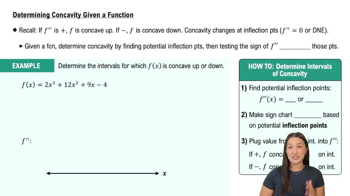
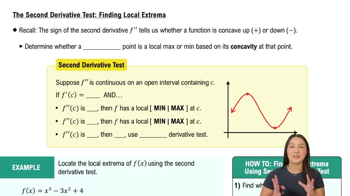
Concavity Determine the intervals on which the following functions are concave up or concave down. Identify any inflection points.
f(x) = ³√(x - 4)
431
views

 Verified step by step guidance
 05:59
05:59
 06:02
06:02 04:50
04:50Concavity Determine the intervals on which the following functions are concave up or concave down. Identify any inflection points.
f(x) = ³√(x - 4)
Concavity Determine the intervals on which the following functions are concave up or concave down. Identify any inflection points.
g(t) = 3t⁵ - 30t⁴ + 80t³ + 100
Concavity Determine the intervals on which the following functions are concave up or concave down. Identify any inflection points.
f(x) = x⁴eˣ + x
Another pen problem A rancher is building a horse pen on the corner of her property using 1000 ft of fencing. Because of the unusual shape of her property, the pen must be built in the shape of a trapezoid (see figure). <IMAGE>
b. Suppose there is already a fence along the side of the property opposite the side of length y. Find the lengths of the sides that maximize the area of the pen, using 1000 ft of fencing.
Concavity Determine the intervals on which the following functions are concave up or concave down. Identify any inflection points.
f(x) = 2x⁴ + 8x³ + 12x² - x - 2
The arbelos An arbelos is the region enclosed by three mutually tangent semicircles; it is the region inside the larger semicircle and outside the two smaller semicircles (see figure). <IMAGE>
b. Show that the area of the arbelos is the area of a circle whose diameter is the distance BD in the figure.