Let g(t)=t−3t−9. Make two tables, one showing values of g for t=8.9,8.99, and 8.999 and one showing values of g for t=9.1,9.01, and 9.001.
Verified step by step guidance
1
Identify the function g(t) = \(\frac{t-9}{\sqrt{t}\)-3}. This function is undefined at t = 9 because both the numerator and the denominator become zero, leading to an indeterminate form.
To understand the behavior of g(t) as t approaches 9, we will evaluate the function for values of t slightly less than 9 and slightly greater than 9.
Create the first table for values of t less than 9: Calculate g(t) for t = 8.9, 8.99, and 8.999. For each value, substitute t into the function and simplify to find g(t).
Create the second table for values of t greater than 9: Calculate g(t) for t = 9.1, 9.01, and 9.001. Again, substitute each value of t into the function and simplify to find g(t).
Analyze the results from both tables to observe the trend of g(t) as t approaches 9 from both sides. This will help in understanding the limit of g(t) as t approaches 9.
Verified video answer for a similar problem:

This video solution was recommended by our tutors as helpful for the problem above
Video duration:
5m
Play a video:
0 Comments
Key Concepts
Here are the essential concepts you must grasp in order to answer the question correctly.
Limits
Limits are fundamental in calculus, representing the value that a function approaches as the input approaches a certain point. In this question, evaluating the function g(t) as t approaches 9 is crucial, as it may involve determining the limit to handle any indeterminate forms that arise.
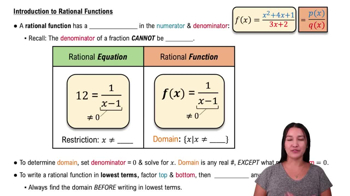
A rational function is a ratio of two polynomials. The function g(t) = (t - 9) / (√t - 3) is a rational function, and understanding its behavior, especially around points where the denominator may approach zero, is essential for analyzing its values and limits.
Creating a table of values involves calculating the output of a function for specific input values. In this question, constructing tables for g(t) at values close to 9 helps visualize the function's behavior and aids in understanding its limit and continuity around that point.