A spherical balloon is inflated and its volume increases at a rate of 15 in³/min. What is the rate of change of its radius when the radius is 10 in?
Verified step by step guidance
1
Start by recalling the formula for the volume of a sphere: V = (4/3)πr³, where V is the volume and r is the radius.
Differentiate the volume formula with respect to time t to find the relationship between the rate of change of volume and the rate of change of radius. This gives us: dV/dt = 4πr²(dr/dt).
Substitute the given rate of change of volume, dV/dt = 15 in³/min, into the differentiated equation: 15 = 4π(10)²(dr/dt).
Solve for dr/dt, the rate of change of the radius, by isolating dr/dt in the equation: dr/dt = 15 / (4π(10)²).
Simplify the expression to find the rate of change of the radius when the radius is 10 inches. This will give you the value of dr/dt in inches per minute.
Verified video answer for a similar problem:
This video solution was recommended by our tutors as helpful for the problem above
Video duration:
7m
Play a video:
0 Comments
Key Concepts
Here are the essential concepts you must grasp in order to answer the question correctly.
Volume of a Sphere
The volume of a sphere is given by the formula V = (4/3)πr³, where V is the volume and r is the radius. This relationship shows how the volume changes with respect to the radius, which is crucial for understanding how the volume increase affects the radius.
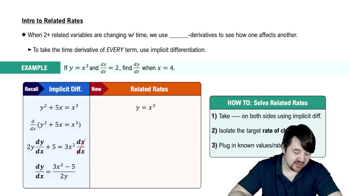
Related rates involve finding the rate at which one quantity changes in relation to another. In this problem, we need to relate the rate of change of the volume of the balloon to the rate of change of its radius, using derivatives to connect these rates.
The chain rule is a fundamental principle in calculus used to differentiate composite functions. In this context, it allows us to express the derivative of the volume with respect to time in terms of the derivative of the radius with respect to time, facilitating the calculation of the radius's rate of change.