39–50. Equations of ellipses and hyperbolas Find an equation of the following ellipses and hyperbolas, assuming the center is at the origin. A hyperbola with vertices (±2, 0) and asymptotes y = ±3x/2
Verified step by step guidance
1
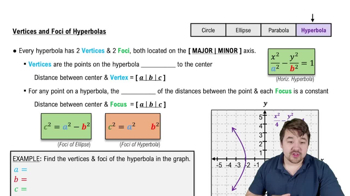
Identify the orientation of the hyperbola based on the vertices. Since the vertices are at (±2, 0), the hyperbola opens horizontally along the x-axis.
Write the standard form of the hyperbola equation centered at the origin with a horizontal transverse axis: \(\frac{x^{2}}{a^{2}} - \frac{y^{2}}{b^{2}} = 1\).
Use the vertices to find \(a\). The vertices are at (±a, 0), so from (±2, 0), we have \(a = 2\), which means \(a^{2} = 4\).
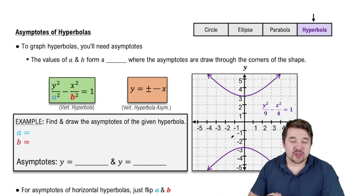
Use the slopes of the asymptotes to find \(b\). For a hyperbola with a horizontal transverse axis, the asymptotes are given by \(y = \pm \frac{b}{a} x\). Given the asymptotes \(y = \pm \frac{3}{2} x\), set \(\frac{b}{a} = \frac{3}{2}\) and solve for \(b\).
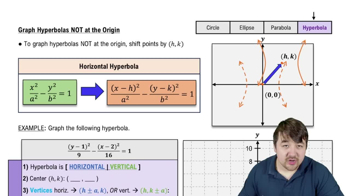
Substitute the values of \(a^{2}\) and \(b^{2}\) into the standard form equation \(\frac{x^{2}}{a^{2}} - \frac{y^{2}}{b^{2}} = 1\) to write the equation of the hyperbola.
Verified video answer for a similar problem:
This video solution was recommended by our tutors as helpful for the problem above
Video duration:
2m
Play a video:
0 Comments
Key Concepts
Here are the essential concepts you must grasp in order to answer the question correctly.
Standard Form of a Hyperbola Centered at the Origin
A hyperbola centered at the origin with a horizontal transverse axis has the equation \( \frac{x^2}{a^2} - \frac{y^2}{b^2} = 1 \). Here, \(a\) is the distance from the center to each vertex along the x-axis, and \(b\) relates to the shape of the hyperbola and its asymptotes.
Vertices are the points where the hyperbola intersects its transverse axis. For a hyperbola centered at the origin with a horizontal transverse axis, the vertices are at \((\pm a, 0)\). Knowing the vertices helps determine the value of \(a\) in the equation.
The asymptotes of a hyperbola provide lines that the curve approaches but never touches. For a hyperbola centered at the origin with a horizontal transverse axis, the asymptotes are given by \( y = \pm \frac{b}{a} x \). Using the slopes of the asymptotes allows solving for \(b\) once \(a\) is known.