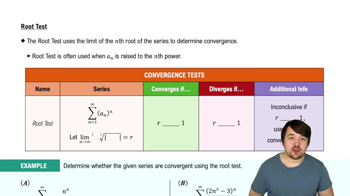
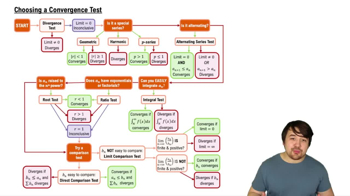
Radius and interval of convergence Use the Ratio Test or the Root Test to determine the radius of convergence of the following power series. Test the endpoints to determine the interval of convergence, when appropriate.
∞ Σ (x/9)³ᵏ k = 0
Verified step by step guidance
1
Identify the general term of the power series. Here, the series is given by \( \sum_{k=0}^{\infty} \left( \frac{x}{9} \right)^{3k} \). The general term \( a_k \) can be written as \( a_k = \left( \frac{x}{9} \right)^{3k} \).
Rewrite the general term to a simpler form if possible. Notice that \( \left( \frac{x}{9} \right)^{3k} = \left( \frac{x^3}{9^3} \right)^k = \left( \frac{x^3}{729} \right)^k \). This shows the series is a geometric series with ratio \( r = \frac{x^3}{729} \).
Apply the Ratio Test or Root Test to find the radius of convergence. For the Ratio Test, compute \( L = \lim_{k \to \infty} \left| \frac{a_{k+1}}{a_k} \right| \). Using the simplified form, \( L = \left| \frac{x^3}{729} \right| \). The series converges when \( L < 1 \), so \( \left| \frac{x^3}{729} \right| < 1 \).
Solve the inequality \( \left| \frac{x^3}{729} \right| < 1 \) to find the interval for \( x \). This simplifies to \( |x^3| < 729 \), which is equivalent to \( |x|^3 < 729 \). Taking cube roots on both sides gives \( |x| < 9 \). This means the radius of convergence \( R = 9 \).
Check the endpoints \( x = -9 \) and \( x = 9 \) by substituting them back into the original series to determine if the series converges at these points. Since the series is geometric with ratio \( r = \left( \frac{x}{9} \right)^3 \), at the endpoints \( r = \pm 1 \). Analyze convergence accordingly.
Verified video answer for a similar problem:
This video solution was recommended by our tutors as helpful for the problem above
Video duration:
5m
Play a video:
0 Comments
Key Concepts
Here are the essential concepts you must grasp in order to answer the question correctly.
Power Series and Convergence
A power series is an infinite sum of terms in the form a_k(x - c)^k, where c is the center. Understanding convergence means determining for which values of x the series sums to a finite value. The radius of convergence defines the distance from c within which the series converges absolutely.
The Ratio Test and Root Test are methods to determine the convergence of infinite series. The Ratio Test examines the limit of |a_{k+1}/a_k|, while the Root Test uses the k-th root of |a_k|. Both tests help find the radius of convergence by analyzing the behavior of terms as k approaches infinity.
The interval of convergence is the set of x-values for which the power series converges. After finding the radius, endpoints must be tested separately because convergence at these points is not guaranteed. Testing endpoints involves substituting them into the series and checking for convergence using appropriate tests.