13–52. Limits of sequences Find the limit of the following sequences or determine that the sequence diverges.
{(1 + (2 / n))ⁿ}
Verified step by step guidance
1
Identify the given sequence as \( a_n = \left(1 + \frac{2}{n}\right)^n \).
Recall the important limit definition related to sequences of the form \( \left(1 + \frac{x}{n}\right)^n \), which approaches \( e^x \) as \( n \to \infty \).
In this problem, recognize that \( x = 2 \), so the sequence resembles \( \left(1 + \frac{2}{n}\right)^n \).
Conclude that the sequence converges and its limit is \( e^2 \).
Verified video answer for a similar problem:
This video solution was recommended by our tutors as helpful for the problem above
Video duration:
6m
Play a video:
0 Comments
Key Concepts
Here are the essential concepts you must grasp in order to answer the question correctly.
Limit of a Sequence
The limit of a sequence is the value that the terms of the sequence approach as the index n becomes very large. If the terms get arbitrarily close to a specific number, the sequence converges to that limit; otherwise, it diverges.
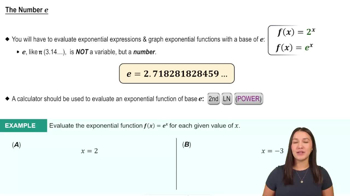
The expression (1 + 1/n)^n is a classic limit that approaches the mathematical constant e as n approaches infinity. Variations like (1 + k/n)^n, where k is a constant, approach e raised to the power k, which helps evaluate similar limits.
The number e (~2.71828) is the base of natural logarithms and arises naturally in limits involving growth processes. It is defined as the limit of (1 + 1/n)^n as n approaches infinity and is fundamental in calculus and exponential functions.

 6:03 minutes
 Verified step by step guidance
 8:22
8:22