37–52. Curves to parametric equations Find parametric equations for the following curves. Include an interval for the parameter values. Answers are not unique.
The line segment starting at P(0, 0) and ending at Q(2, 8)
Verified step by step guidance
1
Identify the points P(0, 0) and Q(2, 8) as the start and end points of the line segment. We want parametric equations that describe all points on the line segment between these two points.
Recall that a parametric equation for a line segment from point P(x_0, y_0) to Q(x_1, y_1) can be written as:
\(x = x_0 + t(x_1 - x_0)\)
\(y = y_0 + t(y_1 - y_0)\),
where the parameter \(t\) varies over an interval.
Substitute the coordinates of P and Q into the parametric form:
\(x = 0 + t(2 - 0) = 2t\)
\(y = 0 + t(8 - 0) = 8t\).
Determine the interval for the parameter \(t\). Since the line segment starts at P when \(t=0\) and ends at Q when \(t=1\), the interval for \(t\) is \(0 \leq t \leq 1\).
Thus, the parametric equations for the line segment are
\(x = 2t\),
\(y = 8t\),
with \(t\) in the interval \([0, 1]\).
Verified video answer for a similar problem:
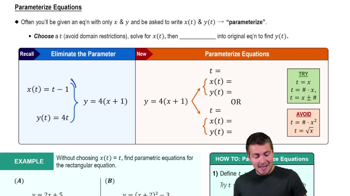
This video solution was recommended by our tutors as helpful for the problem above
Video duration:
2m
Play a video:
0 Comments
Key Concepts
Here are the essential concepts you must grasp in order to answer the question correctly.
Parametric Equations
Parametric equations express the coordinates of points on a curve as functions of a parameter, usually denoted t. Instead of y as a function of x, both x and y depend on t, allowing representation of curves and line segments in a flexible way.
To parameterize a line segment between two points P and Q, use a parameter t that varies over an interval, typically [0,1]. The coordinates are given by linear interpolation: x(t) = x_P + t(x_Q - x_P), y(t) = y_P + t(y_Q - y_P), tracing the segment as t moves from 0 to 1.
The parameter interval defines the range of t values for which the parametric equations describe the curve. For a line segment, choosing t in [0,1] ensures the curve starts at P when t=0 and ends at Q when t=1, covering all points in between.