Tripling time A quantity increases according to the exponential function y(t) = y₀eᵏᵗ. What is the tripling time for the quantity? What is the time required for the quantity to increase p-fold?
Table of contents
- 0. Functions7h 55m
- Introduction to Functions18m
- Piecewise Functions10m
- Properties of Functions9m
- Common Functions1h 8m
- Transformations5m
- Combining Functions27m
- Exponent rules32m
- Exponential Functions28m
- Logarithmic Functions24m
- Properties of Logarithms36m
- Exponential & Logarithmic Equations35m
- Introduction to Trigonometric Functions38m
- Graphs of Trigonometric Functions44m
- Trigonometric Identities47m
- Inverse Trigonometric Functions48m
- 1. Limits and Continuity2h 2m
- 2. Intro to Derivatives1h 33m
- 3. Techniques of Differentiation3h 18m
- 4. Applications of Derivatives2h 38m
- 5. Graphical Applications of Derivatives6h 2m
- 6. Derivatives of Inverse, Exponential, & Logarithmic Functions2h 37m
- 7. Antiderivatives & Indefinite Integrals1h 26m
- 8. Definite Integrals4h 44m
- 9. Graphical Applications of Integrals2h 27m
- 10. Physics Applications of Integrals 3h 16m
- 11. Integrals of Inverse, Exponential, & Logarithmic Functions2h 31m
- 12. Techniques of Integration7h 41m
- 13. Intro to Differential Equations2h 55m
- 14. Sequences & Series5h 36m
- 15. Power Series2h 19m
- 16. Parametric Equations & Polar Coordinates7h 58m
0. Functions
Exponential Functions
Problem 7.2.23a
Textbook Question
Projection sensitivity
According to the 2014 national population projections published by the U.S. Census Bureau, the U.S. population is projected to be 334.4 million in 2020 with an estimated growth rate of 0.79%/yr.
a. Based on these figures, find the doubling time and the projected population in 2050. Assume the growth rate remains constant.
Verified step by step guidance1
Identify the type of growth model: Since the population grows at a constant percentage rate, this is an example of exponential growth, which can be modeled by the formula \(P(t) = P_0 e^{rt}\), where \(P_0\) is the initial population, \(r\) is the growth rate (as a decimal), and \(t\) is time in years.
Convert the given growth rate from a percentage to a decimal: \(0.79\% = 0.0079\) per year. This will be used as the value of \(r\) in the exponential growth formula.
Calculate the doubling time using the formula for exponential growth doubling time: \(T = \frac{\ln(2)}{r}\). This formula comes from setting \(P(t) = 2P_0\) and solving for \(t\).
Calculate the projected population in 2050 by first determining the time elapsed from 2020 to 2050, which is \(t = 30\) years. Then use the exponential growth formula: \(P(30) = 334.4 \times e^{0.0079 \times 30}\), where 334.4 million is the initial population in 2020.
Evaluate the expression for \(P(30)\) to find the projected population in 2050. This will give the population assuming the growth rate remains constant over the 30 years.
Verified video answer for a similar problem:This video solution was recommended by our tutors as helpful for the problem above
Video duration:
3mPlay a video:
0 Comments
Key Concepts
Here are the essential concepts you must grasp in order to answer the question correctly.
Exponential Growth Model
Exponential growth describes a process where the quantity increases at a rate proportional to its current value, often modeled by P(t) = P_0 * e^(rt). Here, P_0 is the initial population, r is the growth rate, and t is time. This model is essential for projecting population changes over time assuming a constant growth rate.
Recommended video:
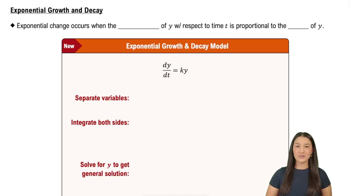
Exponential Growth & Decay
Doubling Time
Doubling time is the period required for a quantity growing exponentially to double in size. It can be calculated using the formula T_d = ln(2)/r, where r is the growth rate expressed as a decimal. This concept helps determine how quickly the population will double under a constant growth rate.
Recommended video:
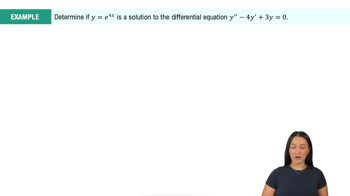
Verifying Solutions of Differential Equations Example 3
Natural Logarithm and Its Application
The natural logarithm (ln) is the inverse of the exponential function and is used to solve for time or growth rate in exponential equations. In population projections, ln helps isolate variables when calculating doubling time or future population values, making it a crucial tool for interpreting growth models.
Recommended video:
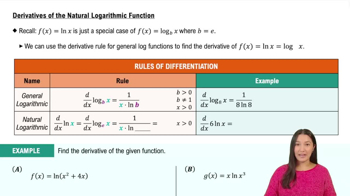
Derivative of the Natural Logarithmic Function
Related Videos
Related Practice
Textbook Question
54
views