In Exercises 51 and 52, give reasons for your answers.
Let f(x) = (x − 2)²ᐟ³.
b. Show that the only local extreme value of f occurs at x = 2.
Verified step by step guidance
1
To find local extreme values, we need to determine where the derivative of the function f(x) = (x - 2)^(2/3) is zero or undefined. Start by finding the derivative f'(x).
Use the chain rule to differentiate f(x). Let u = x - 2, then f(x) = u^(2/3). The derivative f'(x) = (2/3) * u^(-1/3) * du/dx, where du/dx = 1.
Simplify the derivative: f'(x) = (2/3) * (x - 2)^(-1/3). This derivative is undefined at x = 2 because the expression (x - 2)^(-1/3) involves division by zero.
Since f'(x) is undefined at x = 2, check the behavior of f(x) around x = 2 to determine if it is a local extreme value. Consider the sign of f'(x) as x approaches 2 from the left and right.
Observe that as x approaches 2 from the left, f'(x) is negative, and as x approaches 2 from the right, f'(x) is positive. This change in sign indicates that x = 2 is a local minimum.
Verified video answer for a similar problem:
This video solution was recommended by our tutors as helpful for the problem above
Video duration:
6m
Play a video:
0 Comments
Key Concepts
Here are the essential concepts you must grasp in order to answer the question correctly.
Local Extreme Values
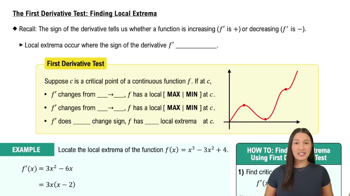
Local extreme values refer to points in the domain of a function where the function takes on a maximum or minimum value relative to nearby points. To identify these points, we typically use the first derivative test, which involves finding critical points where the derivative is zero or undefined, and then analyzing the behavior of the function around these points.
The first derivative test is a method used to determine whether a critical point is a local maximum, local minimum, or neither. By evaluating the sign of the derivative before and after the critical point, we can conclude if the function is increasing or decreasing, thus identifying the nature of the extreme value at that point.
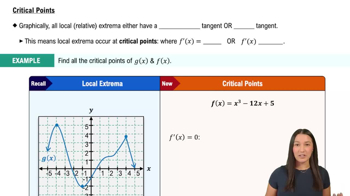
Critical points of a function occur where its derivative is either zero or undefined. These points are essential for finding local extreme values, as they represent potential locations where the function's behavior changes. In the context of the given function f(x) = (x − 2)²/3, identifying critical points will help in determining where the local extreme value occurs.