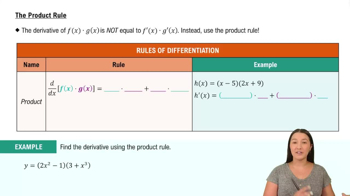
Recognize that the expression y = (sec x + tan x)(sec x − tan x) is a product of two functions. To find dy/dx, we will use the product rule for differentiation, which states that if y = u(x)v(x), then dy/dx = u'(x)v(x) + u(x)v'(x).
Identify the two functions: u(x) = sec x + tan x and v(x) = sec x − tan x.
Differentiate u(x) with respect to x. The derivative of sec x is sec x tan x, and the derivative of tan x is sec^2 x. Therefore, u'(x) = sec x tan x + sec^2 x.
Differentiate v(x) with respect to x. Similarly, v'(x) = sec x tan x - sec^2 x.
Apply the product rule: dy/dx = (sec x tan x + sec^2 x)(sec x − tan x) + (sec x + tan x)(sec x tan x - sec^2 x). Simplify the expression by expanding and combining like terms.
Verified video answer for a similar problem:
This video solution was recommended by our tutors as helpful for the problem above
Video duration:
2m
Play a video:
0 Comments
Key Concepts
Here are the essential concepts you must grasp in order to answer the question correctly.
Product Rule
The Product Rule is a fundamental differentiation technique used when finding the derivative of a product of two functions. It states that if you have two functions u(x) and v(x), the derivative of their product is given by d(uv)/dx = u'v + uv'. This rule is essential for the given problem, as the expression involves the product of two binomials.
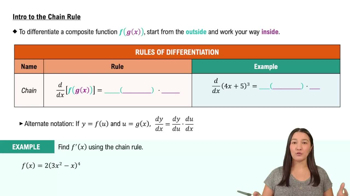
The Chain Rule is another critical differentiation principle that allows us to differentiate composite functions. If a function y is defined as a composition of two functions, say y = f(g(x)), the Chain Rule states that dy/dx = f'(g(x)) * g'(x). This concept may be relevant if the functions within the product involve more complex expressions that require differentiation of inner functions.
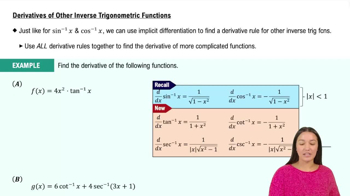
Understanding the derivatives of trigonometric functions is crucial for solving problems involving secant and tangent functions. The derivatives are given by d(sec x)/dx = sec x tan x and d(tan x)/dx = sec^2 x. Recognizing these derivatives will facilitate the differentiation of the given expression, allowing for a more straightforward application of the Product Rule.

 2:00 minutes
 Verified step by step guidance
 05:18
05:18