Position, displacement, and distance A projectile is launched vertically from the ground at t=0, and its velocity in flight (in m/s) is given by v(t)=20−10t. Find the position, displacement, and distance traveled after t seconds, for 0≤t≤4.
Table of contents
- 0. Functions7h 55m
- Introduction to Functions18m
- Piecewise Functions10m
- Properties of Functions9m
- Common Functions1h 8m
- Transformations5m
- Combining Functions27m
- Exponent rules32m
- Exponential Functions28m
- Logarithmic Functions24m
- Properties of Logarithms36m
- Exponential & Logarithmic Equations35m
- Introduction to Trigonometric Functions38m
- Graphs of Trigonometric Functions44m
- Trigonometric Identities47m
- Inverse Trigonometric Functions48m
- 1. Limits and Continuity2h 2m
- 2. Intro to Derivatives1h 33m
- 3. Techniques of Differentiation3h 18m
- 4. Applications of Derivatives2h 38m
- 5. Graphical Applications of Derivatives6h 2m
- 6. Derivatives of Inverse, Exponential, & Logarithmic Functions2h 37m
- 7. Antiderivatives & Indefinite Integrals1h 26m
- 8. Definite Integrals4h 44m
- 9. Graphical Applications of Integrals2h 27m
- 10. Physics Applications of Integrals 3h 16m
- 11. Integrals of Inverse, Exponential, & Logarithmic Functions2h 31m
- 12. Techniques of Integration7h 41m
- 13. Intro to Differential Equations2h 55m
- 14. Sequences & Series5h 36m
- 15. Power Series2h 19m
- 16. Parametric Equations & Polar Coordinates7h 58m
10. Physics Applications of Integrals
Kinematics
Problem 6.RE.9a
Textbook Question
Fuel consumption A small plane in flight consumes fuel at a rate (in gal/min) given by
R'(t) ={ 4t^{1/3} if 0 ≤ t ≤ 8 (take-off)
2 if t> 0 (cruising)
a. Find a function R that gives the total fuel consumed, for 0≤t≤8.
Verified step by step guidance1
Identify the given rate of fuel consumption function for the time interval 0 \leq t \leq 8, which is R'(t) = 4t^{1/3}. This represents the rate of fuel consumption in gallons per minute during take-off.
Recall that to find the total fuel consumed function R(t), you need to integrate the rate function R'(t) with respect to time t over the interval from 0 to t.
Set up the integral: R(t) = \int 4t^{1/3} \, dt. This integral will give the total fuel consumed from time 0 up to time t during take-off.
Perform the integration by applying the power rule for integrals: \int t^{n} \, dt = \frac{t^{n+1}}{n+1} + C. Here, n = \frac{1}{3}, so integrate accordingly and include the constant of integration C.
Use the initial condition R(0) = 0 (since no fuel is consumed at time zero) to solve for the constant C, ensuring the total fuel consumed function R(t) correctly models the situation.
Verified video answer for a similar problem:This video solution was recommended by our tutors as helpful for the problem above
Video duration:
2mPlay a video:
Key Concepts
Here are the essential concepts you must grasp in order to answer the question correctly.
Rate of Change and Derivatives
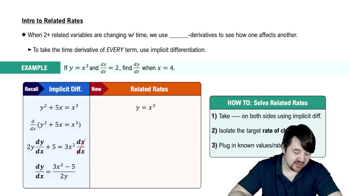
The rate of change represents how a quantity changes over time, often expressed as a derivative. In this problem, R'(t) is the rate of fuel consumption, showing how many gallons are used per minute at time t. Understanding derivatives helps interpret and work with rates in real-world contexts.
Recommended video:
Intro To Related Rates
Integration to Find Accumulated Quantity
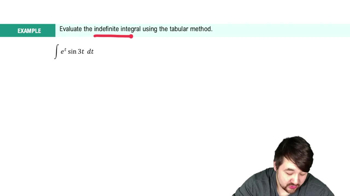
Integration is the reverse process of differentiation and is used to find the total accumulated amount from a rate function. Here, integrating R'(t) over time gives the total fuel consumed, R(t), between 0 and 8 minutes. This concept connects rates to total quantities.
Recommended video:
Tabular Integration by Parts Example 6
Piecewise Functions
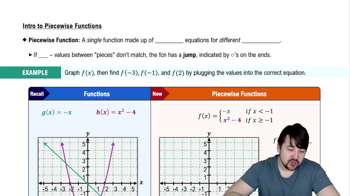
Piecewise functions define different expressions over different intervals. The fuel consumption rate R'(t) changes form at t=8, requiring careful handling of each interval separately. Understanding piecewise functions ensures correct application of integration and interpretation of the problem.
Recommended video:
Piecewise Functions
Watch next
Master Using The Velocity Function with a bite sized video explanation from Patrick
Start learningRelated Videos
Related Practice
Textbook Question
11
views