Radius of convergence Find the radius of convergence for the following power series. ∑ₖ₌₁∞ (1−cos (1/2ᵏ)) xᵏ
Verified step by step guidance
1
Identify the general term of the power series: \(a_k = 1 - \cos\left(\frac{1}{2^k}\right)\), and the series is \(\sum_{k=1}^\infty a_k x^k\).
Recall that the radius of convergence \(R\) of a power series \(\sum a_k x^k\) can be found using the formula \(\frac{1}{R} = \limsup_{k \to \infty} |a_k|^{1/k}\).
Analyze the behavior of \(a_k\) as \(k \to \infty\). Since \(\frac{1}{2^k} \to 0\), use the approximation for cosine near zero: \(\cos y \approx 1 - \frac{y^2}{2}\) for small \(y\).
Use this approximation to find \(\limsup_{k \to \infty} |a_k|^{1/k} \approx \lim_{k \to \infty} \left(\frac{1}{2} 4^{-k}\right)^{1/k} = \lim_{k \to \infty} \left(\frac{1}{2}\right)^{1/k} 4^{-1} = \frac{1}{4}\). Then, the radius of convergence is \(R = \frac{1}{\frac{1}{4}} = 4\).
Verified video answer for a similar problem:
This video solution was recommended by our tutors as helpful for the problem above
Video duration:
6m
Play a video:
0 Comments
Key Concepts
Here are the essential concepts you must grasp in order to answer the question correctly.
Radius of Convergence
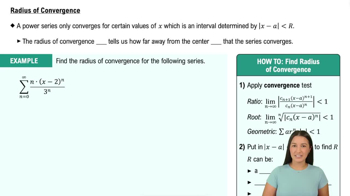
The radius of convergence of a power series is the distance from the center of the series within which the series converges absolutely. It can be found using tests like the root or ratio test, and it determines the interval on the x-axis where the series represents a valid function.
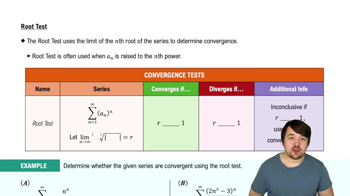
These tests help determine the convergence of infinite series. The root test uses the nth root of the absolute value of terms, while the ratio test uses the limit of the ratio of consecutive terms. Both are commonly applied to find the radius of convergence for power series.
Understanding the limit behavior of the coefficients (here, 1 - cos(1/2^k)) is crucial. Since these coefficients approach zero as k increases, analyzing their asymptotic behavior helps in applying convergence tests effectively to find the radius.