Explain why or why not Determine whether the following statements are true and give an explanation or counter example. b. d²/dx² (sin x) = sin x.
Verified step by step guidance
1
To determine if the statement \( \frac{d^2}{dx^2} (\sin x) = \sin x \) is true, we need to find the second derivative of \( \sin x \).
First, find the first derivative of \( \sin x \). The derivative of \( \sin x \) with respect to \( x \) is \( \cos x \).
Next, find the second derivative by differentiating \( \cos x \). The derivative of \( \cos x \) with respect to \( x \) is \( -\sin x \).
Thus, the second derivative of \( \sin x \) is \( -\sin x \), not \( \sin x \).
Therefore, the statement \( \frac{d^2}{dx^2} (\sin x) = \sin x \) is false. The correct second derivative is \( -\sin x \).
Verified video answer for a similar problem:
This video solution was recommended by our tutors as helpful for the problem above
Video duration:
1m
Play a video:
0 Comments
Key Concepts
Here are the essential concepts you must grasp in order to answer the question correctly.
Second Derivative
The second derivative of a function measures the rate of change of the first derivative. It provides information about the concavity of the function and can indicate points of inflection. In this context, calculating the second derivative of sin x involves differentiating the function twice with respect to x.
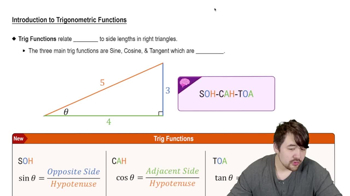
Trigonometric functions, such as sine and cosine, are periodic functions that relate angles to ratios of sides in right triangles. The sine function, sin x, oscillates between -1 and 1 and has a specific pattern of derivatives: the first derivative is cos x, and the second derivative is -sin x.
In calculus, determining the truth of a statement often involves verifying mathematical identities or properties. For the statement d²/dx² (sin x) = sin x, one must compute the second derivative and compare it to sin x to establish its validity, which in this case reveals that the statement is false.

 1:46 minutes
 Verified step by step guidance
 06:02
06:02