Sketching curves Sketch a graph of a function f that is continuous on (-∞,∞) and has the following properties.
f'(x) < 0 and f"(x) > 0 on (-∞,0); f'(x) > 0 and f"(x) < 0 on (0,∞)
Verified step by step guidance
1
Start by understanding the properties of the function f. The function is continuous on (-∞, ∞), meaning there are no breaks, jumps, or holes in the graph.
Analyze the interval (-∞, 0). Here, f'(x) < 0 indicates that the function is decreasing, and f''(x) > 0 suggests that the function is concave up. This means the graph is sloping downwards but curving upwards, resembling a downward-sloping curve that is opening upwards.
Next, consider the interval (0, ∞). In this region, f'(x) > 0 implies the function is increasing, and f''(x) < 0 indicates that the function is concave down. This means the graph is sloping upwards but curving downwards, resembling an upward-sloping curve that is opening downwards.
Identify the behavior at x = 0. Since the function transitions from decreasing and concave up to increasing and concave down, x = 0 is likely a point of inflection where the concavity changes.
Combine these observations to sketch the graph. Start with a curve that decreases and is concave up on (-∞, 0), then smoothly transition at x = 0 to a curve that increases and is concave down on (0, ∞). Ensure the graph is continuous and reflects the described properties.
Verified video answer for a similar problem:

This video solution was recommended by our tutors as helpful for the problem above
Video duration:
3m
Play a video:
0 Comments
Key Concepts
Here are the essential concepts you must grasp in order to answer the question correctly.
Derivative and Its Significance
The derivative of a function, denoted as f'(x), represents the rate of change of the function at a given point. If f'(x) < 0, the function is decreasing, while f'(x) > 0 indicates that the function is increasing. Understanding the sign of the derivative is crucial for determining the behavior of the function across different intervals.
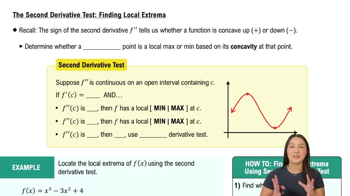
The second derivative, f''(x), provides information about the concavity of the function. If f''(x) > 0, the function is concave up, suggesting that the slope of the function is increasing. Conversely, if f''(x) < 0, the function is concave down, indicating that the slope is decreasing. This concept is essential for sketching the graph accurately.
A function is continuous on an interval if there are no breaks, jumps, or holes in its graph. For the function f to be continuous on (-∞, ∞), it must be defined for all x in that interval and must not have any discontinuities. This property ensures that the function can be graphed smoothly, which is vital for visualizing its behavior based on the given derivative conditions.