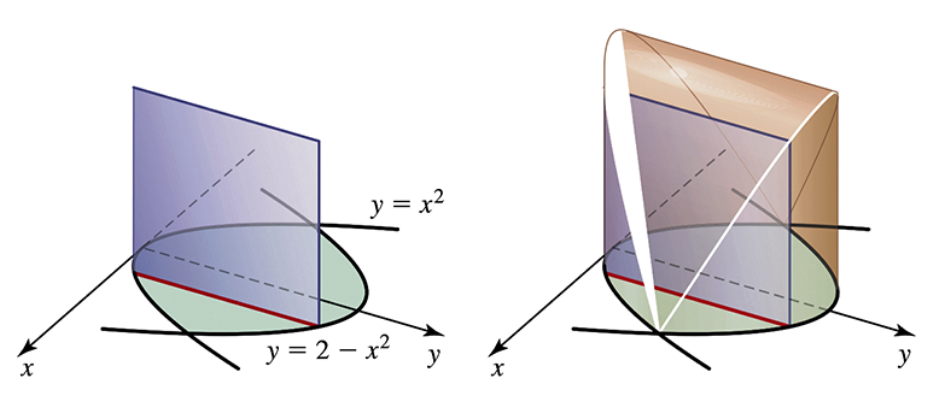
Use the general slicing method to find the volume of the following solids. The solid whose base is the region bounded by the curves y=x^2 and y=2−x^2, and whose cross sections through the solid perpendicular to the x-axis are squares
Verified step by step guidance
1
Identify the region that forms the base of the solid. The base is bounded by the curves \(y = x^2\) and \(y = 2 - x^2\). To find the interval for \(x\), set the curves equal to find the points of intersection: \(x^2 = 2 - x^2\).
Solve the equation \(x^2 = 2 - x^2\) to find the limits of integration. This simplifies to \$2x^2 = 2\(, so \)x^2 = 1\(, giving \)x = -1\( and \)x = 1$ as the bounds for the base region.
Determine the side length of the square cross sections perpendicular to the \(x\)-axis. The side length is the vertical distance between the curves, which is \(s = (2 - x^2) - (x^2) = 2 - 2x^2\).
Express the area of each square cross section as a function of \(x\). Since the cross sections are squares, the area is \(A(x) = s^2 = (2 - 2x^2)^2\).
Set up the integral for the volume using the slicing method. The volume is the integral of the cross-sectional area along the \(x\)-axis from \(-1\) to \$1$: \(V = \int_{-1}^{1} (2 - 2x^2)^2 \, dx\).
Verified video answer for a similar problem:
This video solution was recommended by our tutors as helpful for the problem above
Video duration:
6m
Play a video:
0 Comments
Key Concepts
Here are the essential concepts you must grasp in order to answer the question correctly.
Region Bounded by Curves
The base of the solid is the region bounded by the curves y = x² and y = 2 - x². Finding the intersection points of these curves determines the limits of integration. This region defines the domain over which the cross-sectional areas are calculated.
Cross sections perpendicular to the x-axis are slices of the solid at a fixed x-value. Each cross section is a square whose side length is the vertical distance between the curves y = 2 - x² and y = x². The area of each cross section is the square of this side length.
The volume of the solid is found by integrating the area of cross sections along the x-axis. Using the slicing method, the volume is the integral of the square of the side length of the cross section from the left to right intersection points of the curves.