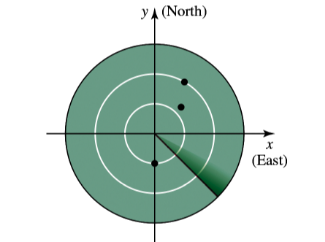
23–24. Radar Airplanes are equipped with transponders that allow air traffic controllers to see their locations on radar screens. Radar gives the distance of the plane from the radar station (located at the origin) and the angular position of the plane, typically measured in degrees clockwise from north. A plane is 50 miles from a radar station at an angle of 10 dgeree clockwise from north. Find polar coordinates for the location of the plane.
Verified step by step guidance
1
Understand the problem setup: The radar station is at the origin (0,0), and the plane's position is given by a distance (radius) and an angle measured clockwise from the north (y-axis).
Identify the given values: The plane is 50 miles from the radar station, and the angle is 10 degrees clockwise from north.
Convert the angle from clockwise from north to the standard polar coordinate angle, which is measured counterclockwise from the positive x-axis (east). Since the angle is 10 degrees clockwise from north, the equivalent angle in standard polar coordinates is \(\theta = 90^\circ - 10^\circ = 80^\circ\).
Express the polar coordinates of the plane as \((r, \theta)\), where \(r\) is the distance from the origin and \(\theta\) is the angle in standard polar form. Here, \(r = 50\) miles and \(\theta = 80^\circ\).
If needed, convert the polar coordinates to Cartesian coordinates using the formulas: \(x = r \cos(\theta)\) and \(y = r \sin(\theta)\), where \(\theta\) is in degrees or radians as appropriate.
Verified video answer for a similar problem:
This video solution was recommended by our tutors as helpful for the problem above
Video duration:
4m
Play a video:
0 Comments
Key Concepts
Here are the essential concepts you must grasp in order to answer the question correctly.
Polar Coordinates
Polar coordinates represent a point in the plane using a distance from the origin (radius) and an angle measured from a reference direction, typically the positive x-axis. In this problem, the plane's location is given by its distance from the radar station and an angle measured clockwise from north, which can be converted to standard polar coordinates.
Angles in polar coordinates are usually measured counterclockwise from the positive x-axis (East). Since the problem gives the angle clockwise from North (positive y-axis), it is essential to convert this angle to the standard polar angle by adjusting the reference direction and direction of measurement.
Relationship Between Cartesian and Polar Coordinates
Polar coordinates (r, θ) can be converted to Cartesian coordinates (x, y) using x = r cos θ and y = r sin θ. Understanding this relationship helps visualize the plane's position on the coordinate plane and interpret the radar data in terms of standard coordinate systems.