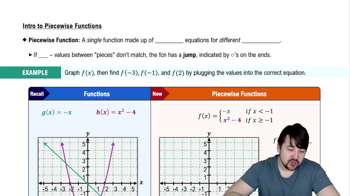
Understand that the function f(x) = |x| is the absolute value function, which is defined as f(x) = x for x >= 0 and f(x) = -x for x < 0.
Recognize that the graph of f(x) = |x| is V-shaped, with a vertex at the origin (0,0). The function is linear on both sides of the vertex.
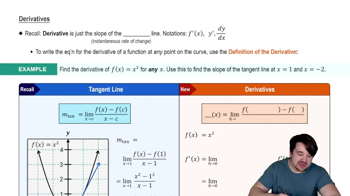
To find the derivative f′(x), consider the piecewise nature of f(x). For x > 0, f(x) = x, so f′(x) = 1. For x < 0, f(x) = -x, so f′(x) = -1.
At x = 0, the function f(x) = |x| is not differentiable because the left-hand derivative and the right-hand derivative do not match. The left-hand derivative is -1, and the right-hand derivative is 1.
Conclude that f′(x) is a piecewise function: f′(x) = 1 for x > 0, f′(x) = -1 for x < 0, and f′(x) is undefined at x = 0.
Verified video answer for a similar problem:
This video solution was recommended by our tutors as helpful for the problem above
Video duration:
3m
Play a video:
0 Comments
Key Concepts
Here are the essential concepts you must grasp in order to answer the question correctly.
Absolute Value Function
The absolute value function, denoted as f(x) = |x|, outputs the non-negative value of x regardless of its sign. This function has a V-shaped graph that meets the x-axis at the origin (0,0) and is symmetric about the y-axis. Understanding this function is crucial for analyzing its behavior, particularly at the point where x = 0, where the function changes direction.
The derivative of a function, denoted as f'(x), represents the rate of change of the function with respect to x. It is calculated as the limit of the average rate of change as the interval approaches zero. For piecewise functions like f(x) = |x|, the derivative can differ based on the interval, highlighting the importance of understanding where the function is continuous and differentiable.
Piecewise functions are defined by different expressions based on the input value. For f(x) = |x|, it can be expressed as f(x) = x for x ≥ 0 and f(x) = -x for x < 0. This distinction is essential for finding the derivative, as the slope of the function changes at the point where the definition switches, particularly at x = 0, where the derivative does not exist due to a cusp.

 3:33 minutes
 Verified step by step guidance
 06:37
06:37