94. The family f(x) = 1/xᵖ revisited Consider the family of functions f(x) = 1/xᵖ, where p is a real number. For what values of p does the integral ∫(1 to ∞) 1/xᵖ dx exist? What is its value when it exists?
Verified step by step guidance
1
Identify the integral to evaluate: \(\displaystyle \int_1^{\infty} \frac{1}{x^p} \, dx\) where \(p\) is a real number.
Rewrite the integral as an improper integral with a limit: \(\displaystyle \lim_{t \to \infty} \int_1^t x^{-p} \, dx\).
Find the antiderivative of the integrand \(x^{-p}\). For \(p \neq 1\), the antiderivative is \(\displaystyle \frac{x^{-p+1}}{-p+1} + C\).
Evaluate the definite integral from 1 to \(t\): \(\displaystyle \int_1^t x^{-p} \, dx = \left[ \frac{x^{-p+1}}{-p+1} \right]_1^t = \frac{t^{-p+1} - 1}{-p+1}\).
Analyze the limit as \(t \to \infty\) to determine for which values of \(p\) the integral converges. Specifically, consider the behavior of \(t^{-p+1}\) as \(t \to \infty\) and find the condition on \(p\) that makes the limit finite.
Verified video answer for a similar problem:
This video solution was recommended by our tutors as helpful for the problem above
Video duration:
3m
Play a video:
0 Comments
Key Concepts
Here are the essential concepts you must grasp in order to answer the question correctly.
Improper Integrals
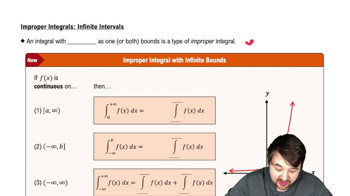
Improper integrals involve integration over an infinite interval or where the integrand becomes unbounded. To determine convergence, we evaluate the limit of the definite integral as the upper bound approaches infinity. If this limit exists and is finite, the integral converges; otherwise, it diverges.
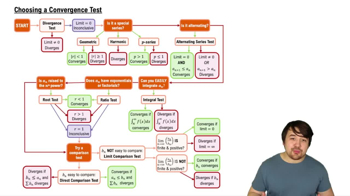
The p-test helps determine the convergence of integrals of the form ∫(1 to ∞) 1/x^p dx. Specifically, the integral converges if and only if p > 1, and diverges otherwise. This is because the decay rate of 1/x^p must be sufficiently fast to produce a finite area under the curve.
To find the value of ∫(1 to ∞) 1/x^p dx when it converges, we compute the antiderivative of x^(-p), which is (x^(-p+1))/(-p+1) for p ≠ 1, and then evaluate the limit as the upper bound approaches infinity. This process yields a finite value when p > 1.