25–28. Horizontal and vertical tangents Find the points at which the following polar curves have horizontal or vertical tangent lines. r = 4 cos θ
Verified step by step guidance
1
Recall that for a polar curve given by \(r = f(\theta)\), the Cartesian coordinates are \(x = r \cos \theta\) and \(y = r \sin \theta\).
To find the slope of the tangent line, compute \(\frac{dy}{dx} = \frac{\frac{dy}{d\theta}}{\frac{dx}{d\theta}}\). This requires finding \(\frac{dx}{d\theta}\) and \(\frac{dy}{d\theta}\) using the product and chain rules.
Calculate \(\frac{dx}{d\theta} = \frac{d}{d\theta} (r \cos \theta) = \frac{dr}{d\theta} \cos \theta - r \sin \theta\) and \(\frac{dy}{d\theta} = \frac{d}{d\theta} (r \sin \theta) = \frac{dr}{d\theta} \sin \theta + r \cos \theta\).
Find \(\frac{dr}{d\theta}\) by differentiating \(r = 4 \cos \theta\), so \(\frac{dr}{d\theta} = -4 \sin \theta\).
Set the numerator of \(\frac{dy}{dx}\) equal to zero to find horizontal tangents (where \(\frac{dy}{d\theta} = 0\) and \(\frac{dx}{d\theta} \neq 0\)), and set the denominator equal to zero to find vertical tangents (where \(\frac{dx}{d\theta} = 0\) and \(\frac{dy}{d\theta} \neq 0\)). Solve these equations for \(\theta\) and then find the corresponding points \((r, \theta)\).
Verified video answer for a similar problem:
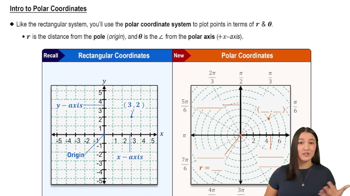
This video solution was recommended by our tutors as helpful for the problem above
Video duration:
9m
Play a video:
0 Comments
Key Concepts
Here are the essential concepts you must grasp in order to answer the question correctly.
Polar Coordinates and Polar Curves
Polar coordinates represent points using a radius and an angle (r, θ) instead of Cartesian coordinates (x, y). Polar curves are equations expressed in terms of r and θ, describing shapes based on the distance from the origin and the angle. Understanding how to interpret and plot these curves is essential for analyzing their properties.
To find tangent lines to polar curves, we convert the polar equation to parametric form (x = r cos θ, y = r sin θ) and compute dy/dx using derivatives with respect to θ. The slope of the tangent line is given by (dy/dθ) / (dx/dθ). This derivative helps identify where the tangent is horizontal or vertical.
A horizontal tangent occurs where the slope dy/dx = 0, meaning dy/dθ = 0 while dx/dθ ≠ 0. A vertical tangent occurs where the slope is undefined, meaning dx/dθ = 0 while dy/dθ ≠ 0. Applying these conditions to the derivatives of the polar curve reveals the points with horizontal or vertical tangents.