65-76. Volumes Find the volume of the described solid of revolution or state that it does not exist. 72. The region bounded by f(x) = (x + 1)^(-3/2) and the x-axis on the interval (-1, 1] is revolved about the line y = -1.
Verified step by step guidance
1
Identify the region to be revolved: The region is bounded by the curve \(f(x) = (x + 1)^{-3/2}\) and the x-axis on the interval \((-1, 1]\). Note that \(f(x)\) is positive on this interval since \((x+1) > 0\) for \(x > -1\).
Determine the axis of revolution: The region is revolved about the line \(y = -1\). Since the curve is above the x-axis and the axis of revolution is below the x-axis, the radius of the solid at each \(x\) will be the vertical distance from the curve to \(y = -1\).
Express the radius of the solid at a point \(x\): The distance from the curve \(y = f(x)\) to the line \(y = -1\) is \(R(x) = f(x) - (-1) = f(x) + 1 = (x + 1)^{-3/2} + 1\).
Set up the volume integral using the disk/washer method: The volume \(V\) is given by integrating the cross-sectional area \(\\pi [R(x)]^2\) along the interval \(x \in (-1, 1]\). So, write the integral as \(V = \\pi \\int_{-1}^{1} \\left[(x + 1)^{-3/2} + 1\\right]^2 \, dx\).
Check for convergence of the integral: Since \(f(x) = (x+1)^{-3/2}\) has a vertical asymptote at \(x = -1\), analyze the behavior of the integrand near \(x = -1\) to determine if the improper integral converges. This will tell you whether the volume exists or not.
Verified video answer for a similar problem:
This video solution was recommended by our tutors as helpful for the problem above
Video duration:
11m
Play a video:
0 Comments
Key Concepts
Here are the essential concepts you must grasp in order to answer the question correctly.
Volume of Solids of Revolution
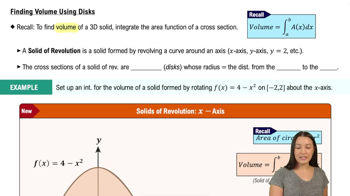
This concept involves finding the volume generated when a region in the plane is revolved around a given axis. Common methods include the disk/washer method and the shell method, which use integration to sum infinitesimal volumes. Understanding the axis of rotation and the shape of the region is crucial for setting up the integral correctly.
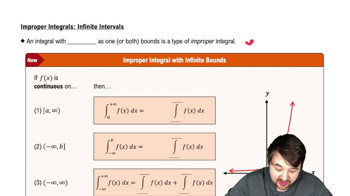
When the function or interval involves infinite behavior or discontinuities, the volume integral may be improper. Determining whether the integral converges (has a finite value) or diverges is essential to conclude if the volume exists. This requires analyzing the behavior of the function near problematic points, such as where it approaches infinity.
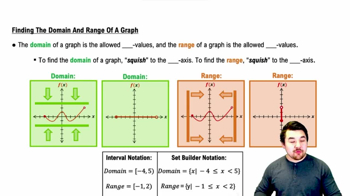
Understanding the function f(x) = (x + 1)^(-3/2) and its domain is key, especially since it involves a negative fractional exponent causing a vertical asymptote at x = -1. Recognizing how the function behaves near the boundary and on the given interval helps in setting up the volume integral and assessing convergence.