81–88. Arc length Find the arc length of the following curves on the given interval.
x = eᵗ sin t, y = eᵗ cos t; 0 ≤ t ≤ 2π
Verified step by step guidance
1
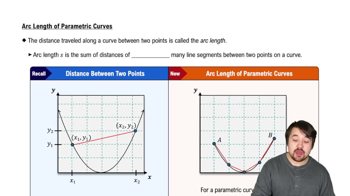
Recall the formula for the arc length of a parametric curve given by \(x = x(t)\) and \(y = y(t)\) over the interval \(a \leq t \leq b\):
\[L = \int_a^b \sqrt{\left(\frac{dx}{dt}\right)^2 + \left(\frac{dy}{dt}\right)^2} \, dt\]
Find the derivatives \(\frac{dx}{dt}\) and \(\frac{dy}{dt}\) for the given functions:
\[x = e^t \sin t, \quad y = e^t \cos t\]
Use the product rule for differentiation since both \(x\) and \(y\) are products of \(e^t\) and trigonometric functions.
Substitute \(\frac{dx}{dt}\) and \(\frac{dy}{dt}\) into the arc length formula under the square root:
\[\sqrt{(e^t \sin t + e^t \cos t)^2 + (e^t \cos t - e^t \sin t)^2}\]
Simplify the expression inside the square root by expanding and combining like terms.
Set up the integral for the arc length over the interval \(0 \leq t \leq 2\pi\):
\[L = \int_0^{2\pi} \sqrt{(\frac{dx}{dt})^2 + (\frac{dy}{dt})^2} \, dt\]
After simplification, evaluate or express the integral in a form ready for calculation.
Verified video answer for a similar problem:
This video solution was recommended by our tutors as helpful for the problem above
Video duration:
8m
Play a video:
0 Comments
Key Concepts
Here are the essential concepts you must grasp in order to answer the question correctly.
Parametric Equations
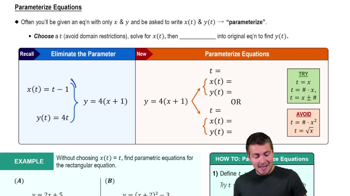
Parametric equations express the coordinates of a curve as functions of a parameter, often denoted t. Instead of y as a function of x, both x and y depend on t, allowing the description of more complex curves. Understanding how to work with parametric forms is essential for calculating properties like arc length.
The arc length of a curve defined parametrically by x(t) and y(t) from t = a to t = b is given by the integral of the square root of (dx/dt)² + (dy/dt)² dt. This formula sums the infinitesimal distances along the curve, providing the total length over the interval.
Differentiation of Exponential and Trigonometric Functions
Calculating dx/dt and dy/dt requires differentiating functions involving products of exponentials and trigonometric terms. Mastery of the product rule and derivatives of e^t, sin t, and cos t is necessary to correctly find these derivatives and proceed with the arc length calculation.