A culture of bacteria has a population of 150 cells when it is first observed. The population doubles every 12hr, which means its population is governed by the function p(t)=150⋅212t, where t is the number of hours after the first observation. How long does it take the population to reach 10,000?
Verified step by step guidance
1
Identify the given function for the population of bacteria: \( p(t) = 150 \cdot 2^{\frac{t}{12}} \). This function describes how the population changes over time, where \( t \) is the time in hours.
Set the population function equal to 10,000 to find the time \( t \) when the population reaches this number: \( 150 \cdot 2^{\frac{t}{12}} = 10,000 \).
Divide both sides of the equation by 150 to isolate the exponential term: \( 2^{\frac{t}{12}} = \frac{10,000}{150} \).
Calculate \( \frac{10,000}{150} \) to simplify the equation: \( 2^{\frac{t}{12}} = 66.67 \).
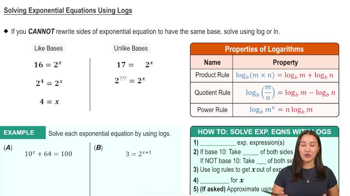
Take the logarithm of both sides to solve for \( t \): \( \log(2^{\frac{t}{12}}) = \log(66.67) \). Use the property of logarithms \( \log(a^b) = b \cdot \log(a) \) to rewrite the left side as \( \frac{t}{12} \cdot \log(2) = \log(66.67) \). Solve for \( t \) by multiplying both sides by 12 and dividing by \( \log(2) \).
Verified video answer for a similar problem:
This video solution was recommended by our tutors as helpful for the problem above
Video duration:
3m
Play a video:
0 Comments
Key Concepts
Here are the essential concepts you must grasp in order to answer the question correctly.
Exponential Growth
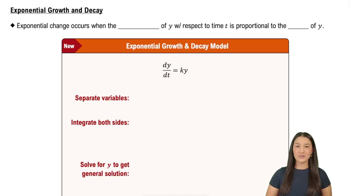
Exponential growth occurs when a quantity increases at a rate proportional to its current value. In this context, the bacteria population doubles every 12 hours, which can be modeled by an exponential function. This type of growth is characterized by a rapid increase, leading to large populations over time, and is commonly represented mathematically as p(t) = p0 * e^(kt), where p0 is the initial amount, k is the growth rate, and t is time.
The population function p(t) = 150 * 2^(t/12) describes the number of bacteria at time t, where 150 is the initial population and the factor 2^(t/12) accounts for the doubling every 12 hours. Understanding this function is crucial for determining how long it takes for the population to reach a specific size, such as 10,000 cells. This function illustrates how the population grows over time based on the initial conditions and growth rate.
To find the time it takes for the population to reach 10,000 cells, one must solve the equation 10,000 = 150 * 2^(t/12). This involves isolating the exponential term and applying logarithms to both sides to solve for t. Mastery of solving exponential equations is essential in calculus, as it allows for the determination of time or other variables in growth models, which is a common application in biological and economic contexts.