Use the table to evaluate the given compositions. <IMAGE>
g(ƒ(h(4)))
Verified step by step guidance
1
Identify the innermost function in the composition, which is \( h(4) \).
Use the table to find the value of \( h(4) \).
Substitute the value of \( h(4) \) into the next function, \( f(x) \), to find \( f(h(4)) \).
Use the table to find the value of \( f(h(4)) \).
Substitute the value of \( f(h(4)) \) into the outermost function, \( g(x) \), to find \( g(f(h(4))) \).
Verified video answer for a similar problem:
This video solution was recommended by our tutors as helpful for the problem above
Video duration:
1m
Play a video:
0 Comments
Key Concepts
Here are the essential concepts you must grasp in order to answer the question correctly.
Function Composition
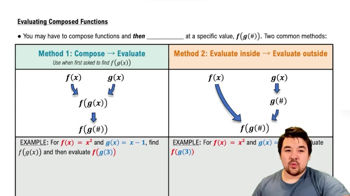
Function composition involves combining two or more functions to create a new function. If you have functions f(x) and g(x), the composition g(f(x)) means you first apply f to x, then apply g to the result of f. Understanding how to evaluate compositions is crucial for solving problems that involve multiple functions.
Evaluating a function means substituting a specific input value into the function to find the output. For example, if f(x) = x + 2, then f(4) = 4 + 2 = 6. In the context of compositions, you must evaluate the innermost function first and use its output as the input for the next function.
The order of operations is a set of rules that dictates the sequence in which mathematical operations should be performed. In function compositions, this means evaluating from the innermost function outward. This principle is essential to ensure that you arrive at the correct final result when dealing with multiple functions.