Acceleration A drag racer accelerates at a(t)=88 ft/s². Assume v(0)=0, s(0)=0, and t is measured in seconds.
c. At this rate, how long will it take the racer to travel 1/4 mi?
Verified step by step guidance
1
Identify the given acceleration function: \(a(t) = 88\) ft/s², which is constant.
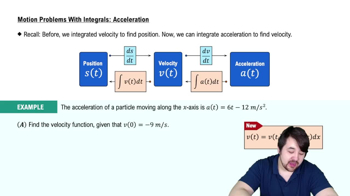
Since acceleration is the derivative of velocity, integrate \(a(t)\) with respect to \(t\) to find the velocity function \(v(t)\):
\[v(t) = \int a(t) \, dt = \int 88 \, dt = 88t + C_1\]
Use the initial condition \(v(0) = 0\) to solve for \(C_1\).
Next, velocity is the derivative of position, so integrate \(v(t)\) to find the position function \(s(t)\):
\[s(t) = \int v(t) \, dt = \int 88t \, dt = 44t^2 + C_2\]
Use the initial condition \(s(0) = 0\) to solve for \(C_2\).
Convert the distance to consistent units:
Since \$1\( mile = \)5280$ feet, \(\frac{1}{4}\) mile = \(\frac{1}{4} \times 5280 = 1320\) feet.
Set the position function equal to \$1320\( feet and solve for \)t\(:
\[44t^2 = 1320\]
Solve this equation to find the time \)t$ it takes to travel \(\frac{1}{4}\) mile.
Verified video answer for a similar problem:

This video solution was recommended by our tutors as helpful for the problem above
Video duration:
4m
Play a video:
0 Comments
Key Concepts
Here are the essential concepts you must grasp in order to answer the question correctly.
Acceleration and Its Relationship to Velocity and Displacement
Acceleration is the rate of change of velocity with respect to time. Given a constant acceleration, velocity can be found by integrating acceleration over time, and displacement can be found by integrating velocity. This relationship allows us to determine how velocity and position evolve from acceleration.
When acceleration is constant, velocity increases linearly over time, and displacement follows a quadratic function of time. Specifically, velocity is a(t) multiplied by time plus initial velocity, and displacement is (1/2) times acceleration times time squared plus initial displacement.
To solve for time when given a distance in miles, it is essential to convert miles to feet to match the units of acceleration (ft/s²). Since 1 mile equals 5280 feet, converting 1/4 mile to feet ensures consistent units for accurate calculation.