24–34. Curve sketching Use the guidelines given in Section 4.4 to make a complete graph of the following functions on their domains or on the given interval. Use a graphing utility to check your work. ƒ(x) = 10x² / (x² + 3)
Verified step by step guidance
1
Identify the domain of the function. Since the function is a rational function, it is defined for all real numbers except where the denominator is zero. Here, the denominator \(x^2 + 3\) is never zero, so the domain is all real numbers.
Find the intercepts. For the y-intercept, set \(x = 0\) and solve \(f(0) = \frac{10(0)^2}{0^2 + 3} = 0\). For x-intercepts, set \(f(x) = 0\) and solve \(10x^2 = 0\), which gives \(x = 0\). Thus, the only intercept is at the origin (0,0).
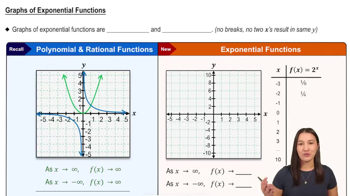
Determine the asymptotic behavior. Since the degree of the numerator and denominator are the same, the horizontal asymptote is given by the ratio of the leading coefficients, \(y = \frac{10}{1} = 10\). There are no vertical asymptotes as the denominator is never zero.
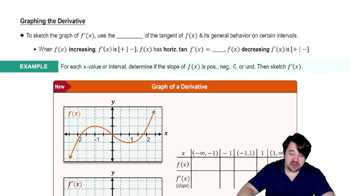
Analyze the first derivative \(f'(x)\) to find critical points and determine intervals of increase and decrease. Use the quotient rule: \(f'(x) = \frac{d}{dx}\left(\frac{10x^2}{x^2 + 3}\right)\). Simplify and solve \(f'(x) = 0\) to find critical points.
Examine the second derivative \(f''(x)\) to determine concavity and points of inflection. Use the derivative of \(f'(x)\) and solve \(f''(x) = 0\) to find points of inflection. Analyze the sign of \(f''(x)\) to determine concavity on intervals.
Verified video answer for a similar problem:
This video solution was recommended by our tutors as helpful for the problem above
Video duration:
13m
Play a video:
0 Comments
Key Concepts
Here are the essential concepts you must grasp in order to answer the question correctly.
Function Behavior
Understanding the behavior of the function involves analyzing its limits, continuity, and asymptotic behavior. For the given function, ƒ(x) = 10x² / (x² + 3), it's essential to determine how the function behaves as x approaches positive and negative infinity, as well as any critical points where the function may change direction.
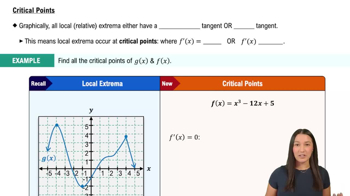
Critical points are found by taking the derivative of the function and setting it to zero. This helps identify local maxima and minima, which are crucial for sketching the graph accurately. For ƒ(x), calculating the derivative will reveal where the slope of the tangent is zero, indicating potential peaks or troughs in the graph.
Graphing techniques involve plotting key features of the function, such as intercepts, critical points, and asymptotes. For ƒ(x), identifying the y-intercept (when x=0) and the x-intercepts (where ƒ(x)=0) will provide anchor points for the graph. Additionally, understanding the end behavior and any horizontal or vertical asymptotes will help in creating a complete and accurate sketch.

 13:32 minutes
 Verified step by step guidance
 5:46
5:46