Inverse sines and cosines Evaluate or simplify the following expressions without using a calculator.
cos (cos⁻¹ ( -1 ))
Verified step by step guidance
1
Recognize that \( \cos^{-1}(-1) \) is asking for the angle whose cosine is \(-1\).
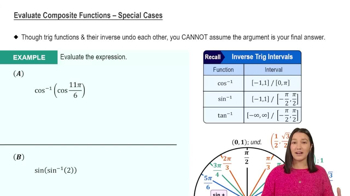
Recall that the range of \( \cos^{-1}(x) \) is \([0, \pi]\).
Determine the angle within this range where the cosine value is \(-1\).
The angle that satisfies \( \cos(\theta) = -1 \) within the range \([0, \pi]\) is \( \pi \).
Substitute \( \pi \) back into the original expression: \( \cos(\pi) \).
Verified video answer for a similar problem:
This video solution was recommended by our tutors as helpful for the problem above
Video duration:
1m
Play a video:
0 Comments
Key Concepts
Here are the essential concepts you must grasp in order to answer the question correctly.
Inverse Trigonometric Functions
Inverse trigonometric functions, such as sin⁻¹(x) and cos⁻¹(x), are used to find angles when given a trigonometric ratio. For example, cos⁻¹(-1) gives the angle whose cosine is -1, which is π radians (or 180 degrees). Understanding these functions is crucial for evaluating expressions involving them.
Derivatives of Other Inverse Trigonometric Functions
Cosine Function
The cosine function, denoted as cos(x), relates the angle x in a right triangle to the ratio of the length of the adjacent side to the hypotenuse. It is periodic and ranges from -1 to 1. Knowing the values of cosine at key angles (like 0, π/2, π, etc.) is essential for simplifying expressions involving cosine.
Composition of functions involves applying one function to the result of another. In this case, evaluating cos(cos⁻¹(-1)) means finding the cosine of the angle whose cosine is -1. This concept is fundamental in calculus and algebra, as it allows for the simplification of complex expressions by breaking them down into manageable parts.

 1:34 minutes
 Verified step by step guidance
 06:35
06:35