Derivatives Find the derivative of the following functions. See Example 2 of Section 3.2 for the derivative of √x. g(x) = 6x⁵ - 5/2 x² + x + 5
Verified step by step guidance
1
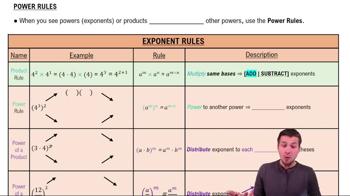
To find the derivative of the function g(x) = 6x⁵ - \(\frac{5}{2}\)x² + x + 5, apply the power rule to each term separately. The power rule states that if f(x) = xⁿ, then f'(x) = n*xⁿ⁻¹.
Start with the first term, 6x⁵. Using the power rule, the derivative is 5 * 6x⁴, which simplifies to 30x⁴.
Next, consider the term -\(\frac{5}{2}\)x². Again, apply the power rule: the derivative is 2 * (-\(\frac{5}{2}\))x¹, which simplifies to -5x.
For the term x, recall that the derivative of x is simply 1, since x is x¹ and applying the power rule gives 1*x⁰ = 1.
The derivative of a constant, such as 5, is 0, because constants do not change and thus have no rate of change.
Verified video answer for a similar problem:

This video solution was recommended by our tutors as helpful for the problem above
Video duration:
3m
Play a video:
0 Comments
Key Concepts
Here are the essential concepts you must grasp in order to answer the question correctly.
Derivatives
A derivative represents the rate of change of a function with respect to its variable. It is a fundamental concept in calculus that provides information about the slope of the tangent line to the curve of the function at any given point. The derivative can be computed using various rules, such as the power rule, product rule, and quotient rule, depending on the form of the function.
The power rule is a basic differentiation rule used to find the derivative of functions in the form of f(x) = x^n, where n is a real number. According to this rule, the derivative f'(x) is given by n*x^(n-1). This rule simplifies the process of differentiation for polynomial functions, making it easier to compute derivatives quickly.
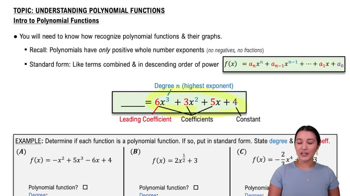
Polynomial functions are mathematical expressions that consist of variables raised to non-negative integer powers, combined using addition, subtraction, and multiplication. The general form is f(x) = a_n*x^n + a_(n-1)*x^(n-1) + ... + a_1*x + a_0, where a_n are coefficients. Understanding polynomial functions is crucial for applying differentiation techniques, as they are commonly encountered in calculus problems.