Table of contents
- 0. Functions(0)
- Introduction to Functions(0)
- Piecewise Functions(0)
- Properties of Functions(0)
- Common Functions(0)
- Transformations(0)
- Combining Functions(0)
- Exponent rules(0)
- Exponential Functions(0)
- Logarithmic Functions(0)
- Properties of Logarithms(0)
- Exponential & Logarithmic Equations(0)
- Introduction to Trigonometric Functions(0)
- Graphs of Trigonometric Functions(0)
- Trigonometric Identities(0)
- Inverse Trigonometric Functions(0)
- 1. Limits and Continuity(0)
- 2. Intro to Derivatives(0)
- 3. Techniques of Differentiation(0)
- 4. Applications of Derivatives(0)
- 5. Graphical Applications of Derivatives(0)
- 6. Derivatives of Inverse, Exponential, & Logarithmic Functions(0)
- 7. Antiderivatives & Indefinite Integrals(0)
- 8. Definite Integrals(0)
- 9. Graphical Applications of Integrals(0)
- 10. Physics Applications of Integrals (0)
- 11. Integrals of Inverse, Exponential, & Logarithmic Functions(0)
- 12. Techniques of Integration(0)
- 13. Intro to Differential Equations(0)
- 14. Sequences & Series(0)
- 15. Power Series(0)
- 16. Parametric Equations & Polar Coordinates(0)
16. Parametric Equations & Polar Coordinates
Conic Sections
16. Parametric Equations & Polar Coordinates
Conic Sections: Videos & Practice Problems
51 of 0
Problem 51Multiple Choice
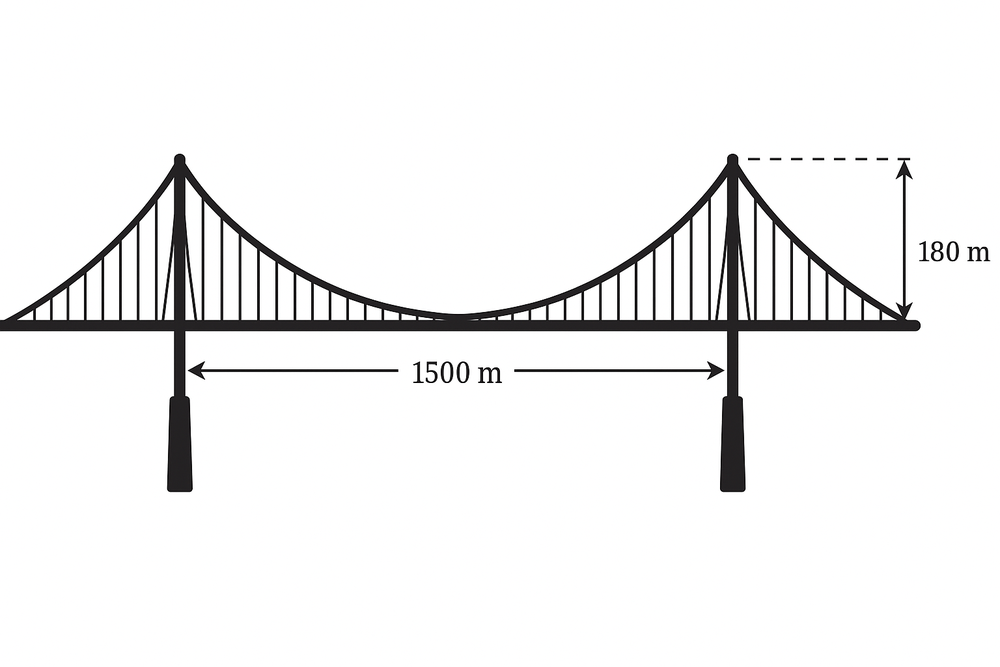
A suspension bridge was constructed with two main towers that are meters apart. The towers rise meters above the deck of the bridge. The cable supporting the deck between the towers forms a parabolic shape. By placing the origin at the midpoint of the bridge deck between the towers, find the quadratic equation that models the shape of the cable. Then, calculate the height of the cable above the deck at a point meters from the center of the bridge.

0 Comments