Skip to main content
Cell Biology
My Course
Learn
Exam Prep
AI Tutor
Study Guides
Flashcards
Explore
Try the app
My Course
Learn
Exam Prep
AI Tutor
Study Guides
Flashcards
Explore
Try the app
Back
DNA Replication definitions
You can tap to flip the card.
Semi-conservative Replication
You can tap to flip the card.
👆
Semi-conservative Replication
Each new DNA molecule contains one original and one newly synthesized strand, ensuring genetic continuity.
Track progress
Control buttons has been changed to "navigation" mode.
1/19
Related flashcards
Related practice
Recommended videos
DNA Replication quiz #1
DNA Replication
40 Terms
DNA Replication quiz #2
DNA Replication
19 Terms
DNA Replication
16. Cell Division
7 problems
Topic
DNA Repair and Recombination
16. Cell Division
7 problems
Topic
16. Cell Division - Part 1 of 2
5 topics
14 problems
Chapter
16. Cell Division - Part 2 of 2
5 topics
13 problems
Chapter
Guided course
14:26
DNA Replication Proteins
540
views
6
rank
Guided course
14:16
Telomeres
401
views
6
rank
Guided course
14:54
Proofreading
443
views
3
rank
Terms in this set (19)
Hide definitions
Semi-conservative Replication
Each new DNA molecule contains one original and one newly synthesized strand, ensuring genetic continuity.
Replication Origin
A specific DNA sequence, often rich in adenine and thymine, where the process of DNA duplication begins.
Replication Fork
Y-shaped region where the DNA double helix is actively unwound to allow synthesis of new strands.
Replication Bubble
A locally unwound segment of DNA where active replication occurs, containing two replication forks.
Leading Strand
The DNA strand synthesized continuously in the 5' to 3' direction, matching the unwinding of the helix.
Lagging Strand
The DNA strand synthesized discontinuously in short fragments, requiring multiple primers.
Okazaki Fragments
Short DNA segments formed on the lagging strand, later joined to create a continuous strand.
RNA Primer
A short RNA sequence providing a starting point for DNA polymerase to begin synthesis.
DNA Polymerase
An enzyme that adds nucleotides to a growing DNA strand, requiring a primer and working 5' to 3'.
Primase
An enzyme that synthesizes short RNA primers, enabling DNA polymerase to initiate replication.
DNA Ligase
An enzyme that seals nicks between Okazaki fragments, forming a continuous DNA strand.
Helicase
A protein that unwinds the DNA double helix by breaking hydrogen bonds between bases.
Single-Stranded Binding Protein
A protein that stabilizes unwound DNA strands, preventing them from re-annealing during replication.
Topoisomerase
An enzyme that relieves supercoiling tension ahead of the replication fork by cutting and rejoining DNA.
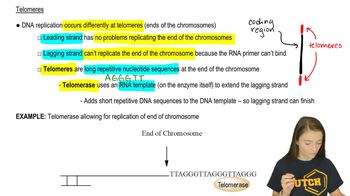
Telomere
A repetitive, non-coding DNA sequence at chromosome ends, protecting genetic information from loss.
Telomerase
A specialized enzyme that extends telomeres, allowing complete replication of chromosome ends.
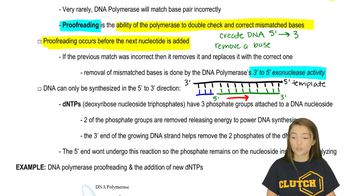
Proofreading
A quality control function of DNA polymerase, correcting mismatched bases during DNA synthesis.
Exonuclease Activity
The ability of DNA polymerase to remove incorrect nucleotides from the end of a growing DNA strand.
dNTP
A deoxyribonucleoside triphosphate, serving as the building block and energy source for DNA synthesis.
 BackBack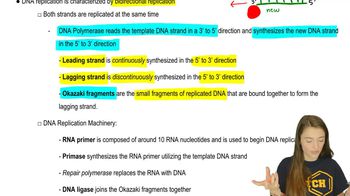
 14:26
14:26