Skip to main content
Cell Biology
My Course
Learn
Exam Prep
AI Tutor
Study Guides
Flashcards
Explore
Try the app
My Course
Learn
Exam Prep
AI Tutor
Study Guides
Flashcards
Explore
Try the app
Back
Mitochondria definitions
You can tap to flip the card.
Mitochondria
You can tap to flip the card.
👆
Mitochondria
Double-membraned organelles with their own DNA, crucial for ATP production and resource exchange within cells.
Track progress
Control buttons has been changed to "navigation" mode.
1/15
Related flashcards
Related practice
Recommended videos
Mitochondria quiz #1
Mitochondria
40 Terms
Mitochondria quiz #2
Mitochondria
40 Terms
Mitochondria quiz #3
Mitochondria
40 Terms
Mitochondria
11. Aerobic Respiration
7 problems
Topic
Citric Acid Cycle
11. Aerobic Respiration
7 problems
Topic
11. Aerobic Respiration
5 topics
15 problems
Chapter
Guided course
10:27
Mitochondria
676
views
11
rank
Terms in this set (15)
Hide definitions
Mitochondria
Double-membraned organelles with their own DNA, crucial for ATP production and resource exchange within cells.
Outer Membrane
The boundary layer containing porin proteins, allowing selective entry of molecules into the organelle.
Porin Proteins
Channel-forming proteins in the outer boundary, enabling passage of ions and small molecules.
Intermembrane Space
Aqueous region between the two boundaries, chemically similar to cytosol and containing cytochrome c.
Cytochrome c
Electron-carrying protein in the intermembrane region, essential for the electron transport chain.
Inner Membrane
Impermeable boundary housing electron transport proteins and ATP synthase, vital for energy production.
Cristae
Folds of the inner boundary that increase surface area, maximizing sites for energy-generating proteins.
ATP Synthase
Enzyme complex embedded in the inner boundary, responsible for synthesizing ATP from ADP and phosphate.
Mitochondrial Matrix
Innermost compartment containing DNA, ribosomes, enzymes, and the site of the citric acid cycle.
Mitochondrial DNA
Circular genetic material within the matrix, encoding some organelle-specific proteins and RNAs.
Ribosomes
Protein-synthesizing structures within the matrix, enabling partial independence from nuclear instructions.
Citric Acid Cycle
Metabolic pathway in the matrix, generating electron carriers for the electron transport chain.
Microtubules
Cytoskeletal elements facilitating organelle movement and positioning within the cell.
Tubular Networks
Fused organelle structures formed for efficient resource sharing and enhanced energy production.
Endosymbiotic Origin
Evolutionary theory explaining the organelle's prokaryotic ancestry and retention of its own genome.
 BackBack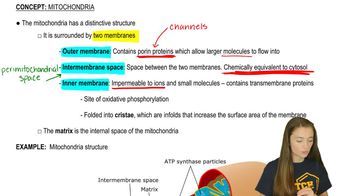
 10:27
10:27