Skip to main content
Cell Biology
My Course
Learn
Exam Prep
AI Tutor
Study Guides
Flashcards
Explore
Try the app
My Course
Learn
Exam Prep
AI Tutor
Study Guides
Flashcards
Explore
Try the app
Back
Overview of the Cell Cycle definitions
You can tap to flip the card.
Interphase
You can tap to flip the card.
👆
Interphase
Period between divisions where the cell grows and prepares for DNA replication, encompassing both gap phases and S phase.
Track progress
Control buttons has been changed to "navigation" mode.
1/15
Related flashcards
Related practice
Recommended videos
Overview of the Cell Cycle quiz #1
Overview of the Cell Cycle
40 Terms
Overview of the Cell Cycle quiz #2
Overview of the Cell Cycle
33 Terms
Overview of the Cell Cycle
16. Cell Division
7 problems
Topic
Control of the Cell Cycle
16. Cell Division
7 problems
Topic
16. Cell Division - Part 1 of 2
5 topics
14 problems
Chapter
16. Cell Division - Part 2 of 2
5 topics
13 problems
Chapter
Guided course
05:03
Cell Cycle Overview
766
views
11
rank
Terms in this set (15)
Hide definitions
Interphase
Period between divisions where the cell grows and prepares for DNA replication, encompassing both gap phases and S phase.
Gap Phases
Growth periods before and after DNA replication, allowing the cell to increase in size and prepare for the next stage.
S Phase
Stage where the cell duplicates its genetic material, ensuring each daughter cell receives a complete genome.
M Phase
Short but critical period where the cell physically divides, including the process of cytokinesis.
Cytokinesis
Physical separation of two newly formed cells, finalizing the division process after mitosis.
Cell Cycle
Repetitive sequence of growth, DNA replication, and division that maintains organismal development and tissue renewal.
Cell Cycle Control System
Network of proteins that regulates progression through the cell cycle, ensuring accuracy and timing of division.
Checkpoint
Regulatory pause point where cellular conditions are verified before advancing to the next cell cycle phase.
G1 Checkpoint
Control point ensuring proper cell growth before DNA replication begins.
G2 Checkpoint
Control point verifying cell growth and DNA replication accuracy before division.
Spindle Assembly Checkpoint
Control mechanism confirming correct microtubule arrangement for accurate chromosome separation.
Mitotic Index
Measurement indicating the proportion of cells undergoing mitosis within a population at a given time.
Eukaryotic Cell Division
Process involving sequential phases that ensure genetic material is accurately distributed to daughter cells.
Stem Cells
Frequently dividing cells capable of generating various specialized cell types for growth and repair.
Cancer
Consequence of disrupted cell cycle control, leading to uncontrolled cell proliferation and potential organismal harm.
 BackBack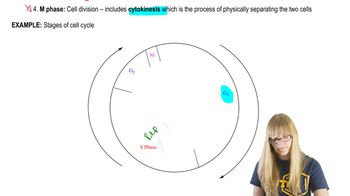
 05:03
05:03