Skip to main content
Cell Biology
My Course
Learn
Exam Prep
AI Tutor
Study Guides
Flashcards
Explore
Try the app
My Course
Learn
Exam Prep
AI Tutor
Study Guides
Flashcards
Explore
Try the app
Back
Passive Transport: Diffusion and Osmosis definitions
You can tap to flip the card.
Passive Transport
You can tap to flip the card.
👆
Passive Transport
Movement of molecules across membranes without energy input, typically from high to low concentration, maintaining equilibrium.
Track progress
Control buttons has been changed to "navigation" mode.
1/15
Related flashcards
Related practice
Recommended videos
Passive Transport: Diffusion and Osmosis quiz #1
Passive Transport: Diffusion and Osmosis
40 Terms
Passive Transport: Diffusion and Osmosis quiz #2
Passive Transport: Diffusion and Osmosis
39 Terms
Passive Transport: Diffusion and Osmosis quiz #3
Passive Transport: Diffusion and Osmosis
40 Terms
Passive Transport: Diffusion and Osmosis
9. Transport Across Membranes
7 problems
Topic
Transporters
9. Transport Across Membranes
7 problems
Topic
9. Transport Across Membranes
5 topics
15 problems
Chapter
Guided course
02:29
GLUT1 Transporter
687
views
10
rank
2
comments
Guided course
04:12
Diffusion
1038
views
11
rank
Guided course
03:15
Osmosis
754
views
10
rank
1
comments
Terms in this set (15)
Hide definitions
Passive Transport
Movement of molecules across membranes without energy input, typically from high to low concentration, maintaining equilibrium.
Diffusion
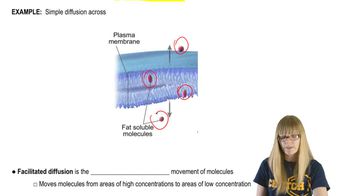
Unassisted movement of molecules toward equilibrium, favoring small, uncharged, non-polar substances across membranes.
Simple Diffusion
Direct passage of small, non-polar molecules through membranes, driven by concentration gradients and lipid solubility.
Facilitated Diffusion
Assisted movement of molecules across membranes via proteins, still following concentration gradients without energy use.
Channel Protein
Membrane protein forming a passageway for specific molecules or ions to cross without conformational changes.
Carrier Protein
Membrane protein that binds molecules and undergoes shape changes to transport them across membranes.
Transport Protein
General class of membrane proteins enabling movement of substances across cell membranes, including channels and carriers.
Uniport
Transport mechanism moving a single type of molecule across a membrane, typically the fastest facilitated diffusion method.
Symport
Transport system moving two different molecules simultaneously in the same direction across a membrane.
Antiport
Transport system moving two different molecules in opposite directions across a membrane, crucial for cellular regulation.
GLUT1
A glucose transporter functioning as a uniport, essential for glucose uptake in cells like those of the gut and intestines.
Sodium-Calcium Antiporter
Membrane protein exchanging sodium and calcium ions in opposite directions, vital for muscle contraction regulation.
Osmosis
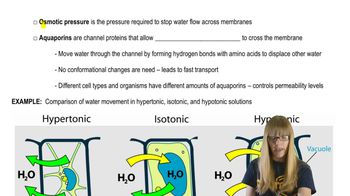
Diffusion of water across semipermeable membranes, driven by differences in solute concentration.
Osmotic Pressure
Pressure required to halt water movement across a membrane, determined by solute concentration differences.
Aquaporin
Channel protein facilitating rapid water movement across membranes via hydrogen bonding, without shape changes.
 BackBack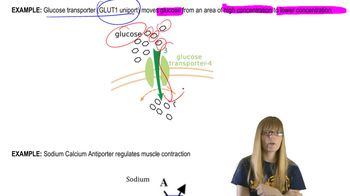
 02:29
02:29