Skip to main content
Cell Biology
My Course
Learn
Exam Prep
AI Tutor
Study Guides
Flashcards
Explore
Try the app
My Course
Learn
Exam Prep
AI Tutor
Study Guides
Flashcards
Explore
Try the app
Back
Principles of Transmembrane Transport definitions
You can tap to flip the card.
Semipermeability
You can tap to flip the card.
👆
Semipermeability
Property allowing selective passage of certain molecules while restricting others, enabling regulation of cellular exchange with the environment.
Track progress
Control buttons has been changed to "navigation" mode.
1/14
Related flashcards
Related practice
Recommended videos
Principles of Transmembrane Transport quiz #1
Principles of Transmembrane Transport
40 Terms
Principles of Transmembrane Transport quiz #2
Principles of Transmembrane Transport
34 Terms
Principles of Transmembrane Transport
9. Transport Across Membranes
7 problems
Topic
Passive Transport: Diffusion and Osmosis
9. Transport Across Membranes
7 problems
Topic
9. Transport Across Membranes
5 topics
15 problems
Chapter
Guided course
03:37
Membranes and Gradients
1147
views
27
rank
3
comments
Guided course
03:11
Passive and Active Transport
1009
views
23
rank
1
comments
Terms in this set (14)
Hide definitions
Semipermeability
Property allowing selective passage of certain molecules while restricting others, enabling regulation of cellular exchange with the environment.
Concentration Gradient
Difference in molecule concentration across a membrane, creating a driving force for movement from high to low concentration.
Electrical Potential
Charge difference across a membrane, resulting from unequal distribution of ions on either side.
Electrochemical Potential
Combined effect of concentration gradient and electrical potential, determining the overall driving force for ion movement.
Membrane Potential
Net difference between concentration gradient and electrical potential, reflecting the overall charge difference across the membrane.
Passive Transport
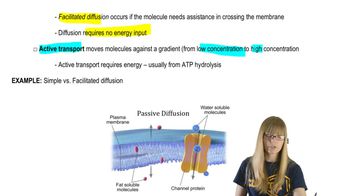
Movement of molecules down a gradient without energy input, occurring via simple or facilitated diffusion.
Simple Diffusion
Unassisted movement of molecules directly through the membrane, requiring no proteins or energy.
Facilitated Diffusion
Transport of molecules across the membrane with the help of proteins, but without energy expenditure.
Active Transport
Energy-dependent movement of molecules against their gradient, typically powered by ATP.
Channel Protein
Membrane protein forming a selective portal, allowing passage based on size or charge.
Transporter
Highly selective membrane protein permitting only specific molecules to bind and cross.
ATP-Powered Pump
Membrane protein using ATP energy to move substances across the membrane against their gradient.
Extracellular Environment
Area outside the cell, differing in composition from the cell's interior and influencing transport processes.
Intracellular Environment
Internal cellular space with distinct concentrations and charges compared to the outside, crucial for maintaining gradients.
 BackBack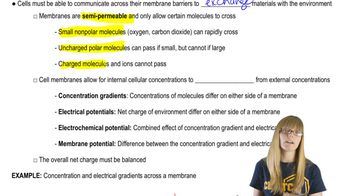
 03:37
03:37