 Back
BackCell Biology: DNA Structure, Function, and Nuclear Processes
 10:54
10:54
Terms in this set (25)
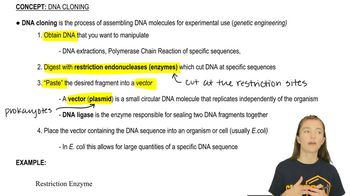
DNA cloning is the process of assembling DNA molecules for experimental use, involving extraction, digestion with restriction enzymes, insertion into vectors, and replication in host cells like E. coli.
DNA ligase is the enzyme responsible for sealing two DNA fragments together during cloning.
Oswald Avery showed that DNA was the genetic material of bacteria through experiments involving bacterial transformation in mice.
Hershey and Chase showed that DNA, not protein, is the genetic material of viruses using radioactively labeled bacteriophages.
Chargaff's rules state that adenine (A) pairs with thymine (T) and cytosine (C) pairs with guanine (G) in DNA.
Phosphodiester bonds connect the 5’ phosphate group of one nucleotide to the 3’ hydroxyl group of the next, giving DNA strand directionality.
DNA is a double helix with two antiparallel strands; the sugar-phosphate backbone forms the outside, and bases face inward forming base pairs with 10 base pairs per helical turn.
B-DNA (common right-handed), A-DNA (shorter right-handed), and Z-DNA (left-handed with unknown significance).
Supercoiling is the twisting of the DNA helix upon itself, which can be relaxed or introduced by topoisomerase enzymes.
Topoisomerase type 2 introduces double-strand breaks to relieve DNA supercoiling tension.
DNA strands separate by breaking hydrogen bonds, caused by heat, pH changes, or UV light; melting temperature (Tm) depends on G-C content.
RNA contains uracil instead of thymine, is usually single-stranded, can form complex 3D structures, and can act as enzymes (ribozymes), unlike DNA.
DNA packaging compacts the long DNA molecules (2 meters in humans) to fit inside the small nucleus (5-8 µm diameter).
A nucleosome is DNA wrapped around a core of eight histone proteins (two each of H2A, H2B, H3, H4), forming the basic unit of chromatin.
Histone H1 acts as a linker histone connecting nucleosomes and is essential for forming the 30nm chromatin fiber.
Interphase chromosomes are less condensed and occupy specific nuclear regions; metaphase chromosomes are highly condensed and visible during cell division.
The centromere is a specialized DNA sequence that holds sister chromatids together and serves as the assembly site for the kinetochore.
A karyotype is an ordered display of an organism's full set of chromosomes, showing homologous pairs.
The nuclear envelope consists of two lipid bilayers; the outer membrane is continuous with the endoplasmic reticulum.
Nuclear pore complexes regulate transport between the nucleus and cytoplasm, allowing molecules larger than 30,000 Daltons to pass selectively.
Ribosomes are synthesized in the nucleolus, which contains rRNA gene copies and proteins for ribosome assembly.
Processed pre-mRNA binds to mRNP exporters and is transported through nuclear pores; only correctly processed mRNA is exported.
The exosome degrades improperly processed RNA and introns remaining in the nucleus.
An NLS is a sequence rich in lysine and arginine that directs proteins to the nucleus for import.
Importin binds NLS-containing proteins in the cytosol, transports them through nuclear pores, then RAN-GTP binds importin to release the cargo inside the nucleus.