 Back
BackCell Biology: Gene Expression and RNA Processing
 01:43
01:43
Terms in this set (20)
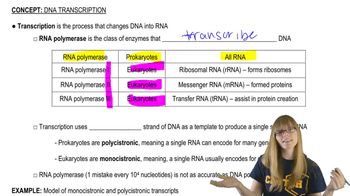
Transcription is the process of converting DNA into RNA using RNA polymerase enzymes.
RNA polymerase I produces rRNA, RNA polymerase II produces mRNA, and RNA polymerase III produces tRNA.
Polycistronic mRNA (prokaryotes) encodes multiple genes in one transcript; monocistronic mRNA (eukaryotes) encodes a single gene per transcript.
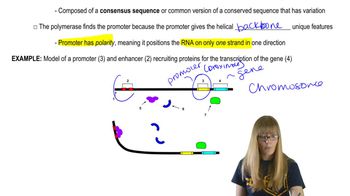
A promoter is a DNA sequence where RNA polymerase binds to initiate transcription, often containing elements like the TATA box.
Transcription factors bind promoters and recruit RNA polymerase II to start transcription, forming the transcription initiation complex.
RNA polymerase synthesizes RNA in the 5’ to 3’ direction, reading the DNA template strand 3’ to 5’.
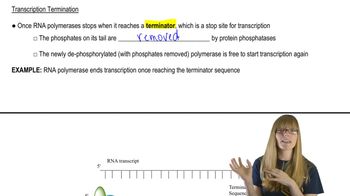
RNA polymerase stops at a terminator sequence; its tail phosphates are removed by phosphatases, allowing polymerase to dissociate and restart transcription.
A codon is a sequence of three nucleotides in mRNA that encodes a single amino acid or a start/stop signal.
The wobble hypothesis allows flexible base pairing at the third codon position, enabling one tRNA to recognize multiple codons.
Aminoacyl tRNA synthetase attaches the correct amino acid to its corresponding tRNA, charging the tRNA for translation.
Prokaryotes: 16S (small subunit), 23S and 5S (large subunit). Eukaryotes: 18S (small), 5S, 5.8S, and 28S (large).
RNA processing occurs in the nucleus before mRNA is exported to the cytoplasm.
The 5’ cap is a methylated guanine added to protect mRNA from degradation and assist in translation initiation.
Polyadenylation is the addition of a poly-A tail at the 3’ end of mRNA, enhancing stability and export.
Splicing requires a 5’ splice site (usually GU), a 3’ splice site (usually AG), and a branch point sequence upstream of the 3’ site.
The spliceosome is a complex of snRNPs and proteins that removes introns from pre-mRNA during splicing.
Binding of U1 to 5’ site, U2 to branch point, spliceosome assembly, cleavage at 5’ site and lariat formation, cleavage at 3’ site, exon ligation, and exon junction complex recruitment.
Alternative splicing produces different mRNA variants by combining exons in various ways, increasing protein diversity.
RNA editing alters nucleotide sequences in pre-mRNA, such as deamination converting cytosine to uridine or adenine to inosine.
Guide RNAs direct the insertion, deletion, or modification of nucleotides during RNA editing.